

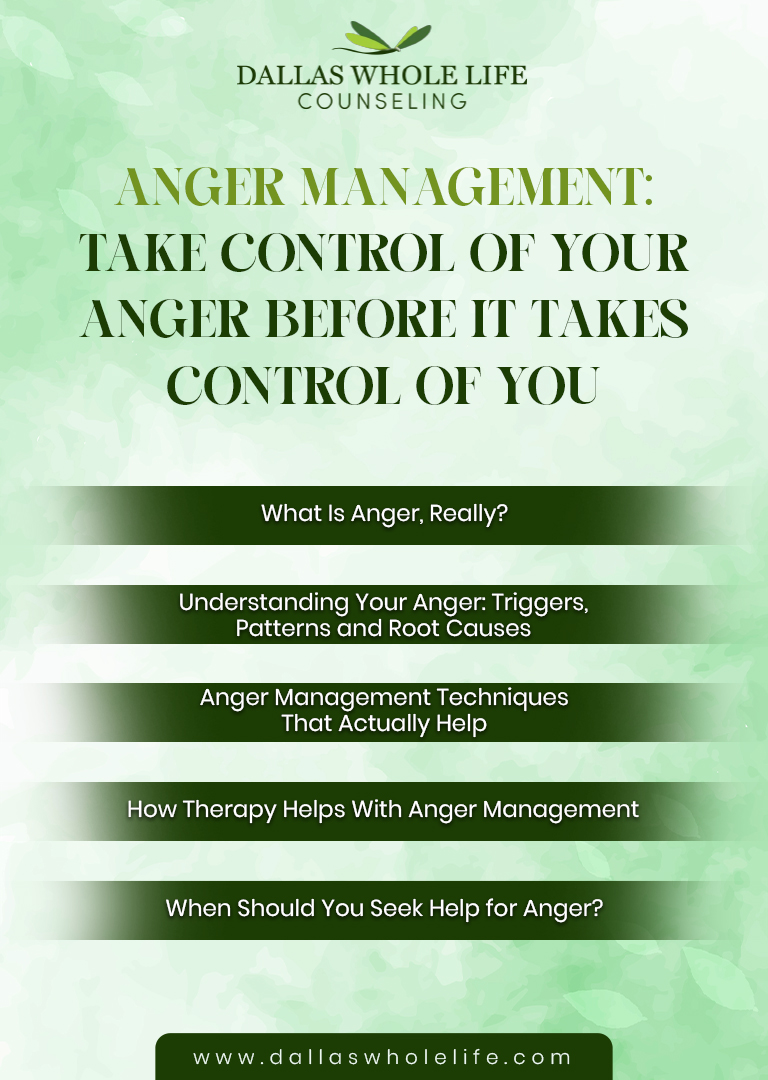
Anger is a normal emotion, but it can become a problem when it feels too intense, happens too often, or leads to words and actions you later regret. Anger management helps you understand your triggers, notice what happens in your body, pause before reacting, and express anger in healthier ways. Therapy, especially Cognitive Behavioral Therapy, can help you break the anger cycle and build more control in your relationships, work and daily life.
Everyone gets angry. You are allowed to feel angry when something feels unfair, hurtful, disrespectful, or out of your control.
Anger itself is not bad.
In fact, anger can sometimes tell us something important. It can show us where a boundary has been crossed, where a need has been ignored, or where something needs to change.
The problem is not usually the feeling.
The problem is what happens next.
Maybe you raise your voice before you realize it.
Maybe you say things you cannot take back.
Maybe you shut down and give people the silent treatment.
Maybe you explode, apologize, promise it will not happen again, then find yourself in the same pattern a week later.
Maybe the people around you seem careful, tense, or afraid of setting you off.
That is usually the sign that anger is no longer just an emotion. It has become a pattern.
At Dallas Whole Life Counseling, we help people understand what is really underneath their anger, learn practical tools to manage it, and express it in ways that do not harm their relationships or themselves.
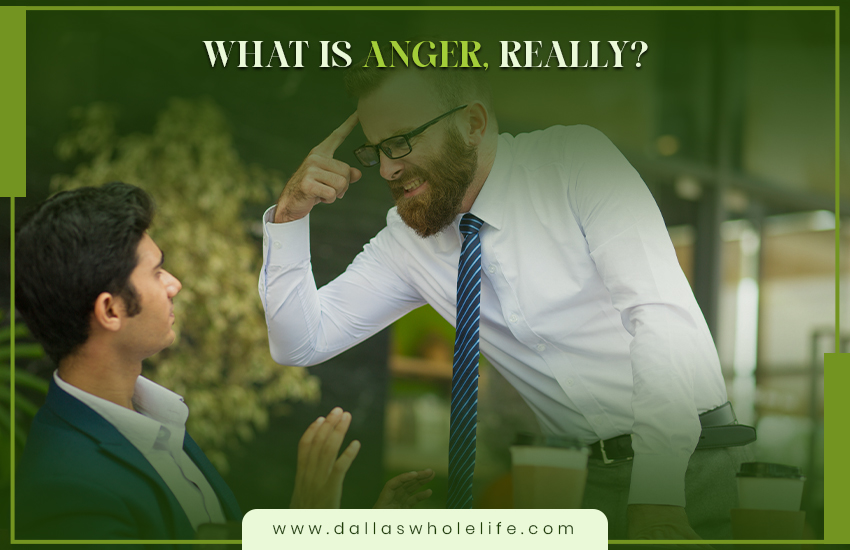
What Is Anger, Really?
Anger is a normal human emotion, but it is often misunderstood. While it can sometimes help you recognize when something feels unfair or needs to change, it can also become harmful if it starts controlling your thoughts, reactions, or relationships. Before learning how to manage anger, it helps to understand what it is, how it affects your mind and body, and when it may be a sign of a deeper issue.
Healthy Anger vs an Anger Problem
Healthy anger can be useful.
It helps you notice when something is wrong and speak up for yourself.
Healthy anger sounds like:
“I need some space before we keep talking.”
“That hurt me, and I want to talk about it.”
“I am frustrated, but I am listening.”
“I disagree, but I am not trying to attack you.”
An anger problem usually looks different.
It may show up as:
- Yelling or screaming
- Insults, sarcasm or name-calling
- Threats
- Intimidation
- Breaking things
- Driving aggressively
- Shutting down for hours or days
- Blaming everyone else
- Feeling out of control once anger starts
- Regretting what you said or did afterwards
- Having the same fight again and again
- People close to you walking on eggshells
The American Psychological Association explains that anger is a normal emotion, but when it gets out of control and becomes destructive, it can create problems at work, in relationships and in your overall quality of life.
That is usually when support can make a real difference.
Physical Signs Your Anger Has Gone Too Far
Anger does not just happen in your mind.
It happens in your body too.
You might notice:
- Tight chest
- Clenched jaw
- Hot face
- Shaking hands
- Racing heart
- Tight shoulders
- Headaches
- Stomach tension
- Fast breathing
- Feeling like you need to move, shout or leave
- Tunnel vision
- Trouble thinking clearly
These body signs matter because they often show up before the outburst.
Learning to catch anger in your body gives you a chance to slow things down before it takes over.
That is a big part of anger management therapy.
We help you recognize the warning signs early, not just clean up the damage afterwards.
Anger and Mental Health Are Often Connected
Anger can be a standalone issue, but it can also be connected to other mental health struggles.
For some people, anger is tied to anxiety.
For others, it is connected to depression, trauma, chronic stress, ADHD, grief, relationship pain, addiction, shame, or burnout.
Sometimes anger is the only emotion that feels safe to show.
For example:
- Anxiety may come out as irritability.
- Depression may come out as snapping at people.
- Trauma may come out as defensiveness or overreacting to perceived threats.
- Stress may come out as impatience.
- Shame may come out as blame.
- Fear may come out as control.
This is why we do not just ask, “How do we stop the anger?”
We also ask, “What is anger trying to protect?”
That question can change everything.
How Anger Affects Relationships, Work and Health
Unresolved anger does not usually stay in one area of life.
It can affect your marriage, parenting, friendships, work, health and self-respect.
In relationships, anger can create distance. People may stop being honest with you because they are afraid of your reaction.
At work, anger can affect trust, communication and decision-making.
At home, anger can make children, partners or family members feel tense and unsafe, even if you never meant to scare anyone.
Anger can also affect your body. NIH reported that brief bouts of anger may impair the ability of blood vessels to expand and contract, which could have consequences for heart health. The American Heart Association also reported similar findings from research published in the Journal of the American Heart Association.
This does not mean one angry moment ruins your health.
It does mean repeated, intense anger is worth taking seriously.
Your body is part of the conversation too.
The Hidden Link Between Anger, Pain and Fear
A lot of anger is really pain with armor on.
That pain may come from:
- Feeling rejected
- Feeling abandoned
- Feeling criticised
- Feeling controlled
- Feeling powerless
- Feeling embarrassed
- Feeling like you are failing
- Feeling like no one listens
- Feeling like you have to carry everything alone
Anger often rushes in because it feels stronger than hurt.
It says, “Do not let them see that this affected you.”
But underneath, something usually did affect you.
Therapy helps you slow down enough to notice what is really happening.
Not so you can excuse harmful behaviour.
So you can understand it, take responsibility for it, and respond differently next time.
Can Anger Lead to Anxiety, Depression or Burnout?
Yes, anger and emotional exhaustion can feed each other.
If you are angry all the time, your body may stay in a constant state of tension.
That can leave you feeling drained, guilty, anxious, ashamed or emotionally numb.
You might start avoiding people because you do not want another fight.
You might replay arguments in your head.
You might feel bad about how you acted, then get defensive because the guilt feels too heavy.
Over time, this can wear you down.
Long-term unresolved anger has been linked with depression and anxiety, and may also lead people to engage in risky behaviors such as alcohol or substance use.
If your anger keeps leaving you exhausted, disconnected, or ashamed, it is not something you have to keep managing alone.
Understanding Your Anger: Triggers, Patterns and Root Causes
Managing anger is about more than calming down in the moment. Lasting change happens when you understand what is fueling your reactions in the first place. Your triggers, thought patterns, past experiences, and emotional responses all play a role in how anger develops and why it can become difficult to control.
Why Do I Get So Angry?
Anger triggers are not always obvious.
Sometimes the trigger is the thing that happened.
Sometimes the trigger is what the thing meant to you.
For example, your partner forgetting to call may not only feel annoying. It may feel like, “I do not matter.”
Your child not listening may not only feel frustrating. It may feel like, “I have no control.”
Your boss giving feedback may not only feel uncomfortable. It may feel like, “I am failing.”
Common anger triggers include:
- Feeling criticised
- Feeling ignored
- Being interrupted
- Feeling disrespected
- Feeling rushed
- Being embarrassed
- Feeling out of control
- Money stress
- Work pressure
- Parenting stress
- Lack of sleep
- Relationship conflict
- Old trauma being activated
- Feeling blamed
- Feeling unappreciated
The goal is not to make sure nothing ever triggers you.
That is not realistic.
The goal is to learn what your triggers are, so they do not keep catching you by surprise.
The Anger Cycle: Why It Keeps Happening
Anger often follows a cycle. It may look like this:
- Something triggers you.
- Your body reacts.
- Your thoughts speed up.
- You interpret the situation as a threat or attack.
- You react quickly.
- The situation escalates.
- There is regret, shame, blame or withdrawal afterwards.
- Nothing really gets resolved.
- The same trigger shows up again later.
This cycle can become automatic.
That is why people often say, “I do not know what happened. I just snapped.”
Therapy helps you slow the cycle down.
Not after the blow-up.
Before it.
That is where change starts.
Why Venting Feels Good but Often Makes Things Worse
A lot of people have been told to “let it out”.
Punch a pillow.
Yell in the car.
Rant until you feel better.
The problem is that venting can sometimes keep the body activated instead of calming it down.
A 2024 meta-analysis on anger management activities found that strategies that reduce arousal, such as deep breathing, mindfulness, and meditation, were more effective for reducing anger and aggression than arousal-increasing activities. The research also found that venting anger did not have strong support as an effective anger management strategy. See the study on anger management activities that increase or decrease arousal.
This does not mean you should bottle anger up.
It means there is a difference between expressing anger and feeding it.
Healthy expression sounds like:
“I am angry, and I need a few minutes.”
“I want to talk about this, but not while I am this worked up.”
“This matters to me, and I need to explain why.”
That is very different from exploding and calling it honesty.
What Happens in Your Body When Anger Takes Over?
When anger rises, your nervous system prepares for action.
Your body may release stress hormones. Your heart rate may climb. Muscles tighten. Breathing gets faster. Your attention narrows.
This can be helpful if you are in real danger.
But in a conversation with your partner, a meeting at work, or a stressful moment with your child, that same response can make things worse.
Your body is preparing to fight, even when what you really need is to pause, listen, think and respond.
This is why anger management is not only about thoughts.
It is also about calming the body.
Before you can think clearly, your nervous system usually needs to come down a few notches.
How Childhood Experiences Shape Adult Anger
Many anger patterns begin earlier than people realise.
You may have grown up in a home where anger was loud and scary.
Or where no one was allowed to express anger at all.
Or where conflict meant rejection.
Or where you had to become defensive to protect yourself.
As an adult, your body may still react as if those old rules are still in place.
You might overreact to criticism because criticism once felt unsafe.
You might shut down during conflict because silence was how you survived.
You might yell because that is what you saw growing up.
You might avoid hard conversations until resentment builds.
Therapy can help you understand where your anger pattern came from.
Then we help you build a new one.
Anger in Men and Women: Are the Patterns Different?
Men and women can both struggle with anger.
The difference is often in how anger has been taught, allowed or judged.
Some men are taught that anger is acceptable, but sadness, fear or vulnerability are not.
Some women are taught that anger is unacceptable, so it gets pushed down until it comes out as resentment, anxiety, shutdown or sudden explosions.
These are not strict rules. Everyone is different.
But it is useful to ask:
What was I taught about anger?
Was I allowed to show it?
Was I punished for it?
Was anger the only emotion people respected?
Did I learn to hide it until I could not anymore?
The answers can tell you a lot.
Anger and Anxiety Can Feed Each Other
Anger and anxiety often travel together.
Anxiety says, “Something is wrong.”
Anger says, “I need to do something about it right now.”
If you are anxious, you may feel more easily overwhelmed. Small things can feel bigger. Changes can feel threatening. Waiting can feel unbearable.
Then anger steps in as a way to regain control.
This can look like:
- Snapping when plans change
- Getting angry when people ask questions
- Feeling irritated by noise, mess or delays
- Controlling details to reduce anxiety
- Blaming others when you feel overwhelmed
When we treat anger, we often look at anxiety too.
Because if anxiety keeps driving the anger, the anger will keep coming back.
When Anger Becomes Abusive
This section matters.
Anger becomes abusive when it is used to control, scare, punish or intimidate another person.
That may include:
- Threats
- Physical violence
- Blocking someone from leaving
- Destroying belongings
- Screaming in someone’s face
- Using fear to get your way
- Repeated humiliation
- Controlling money, movement or communication
- Blaming the other person for your behaviour
Anger can explain why someone reacted strongly.
It does not excuse harm.
If your anger is frightening other people, or if you are afraid you may hurt someone, it is important to get help quickly.
If there is immediate danger, contact emergency services or local crisis support. Safety comes first.

Anger Management Techniques That Actually Help
You do not need to become a different person to manage anger. You need tools you can actually use when your body is activated and your mind is moving too fast. Here are some places to start.
How to Control Anger in the Moment
When anger is already rising, keep it simple.
This is not the time for a deep analysis of your childhood.
This is the time to interrupt the reaction.
Try this:
- Pause before speaking.
- Unclench your jaw.
- Drop your shoulders.
- Take slow breaths.
- Name what is happening: “I am getting angry.”
- Step away if you need to.
- Come back when you can speak without attacking.
The pause is not weakness.
It is control.
It is the space between the feeling and the behaviour.
The Stop, Breathe, Observe Method
This is a simple way to slow anger down.
Stop
Do not keep pushing through the conversation if you are about to say something harmful.
Stop talking for a moment.
Step back if needed.
Breathe
Take slow, steady breaths.
Try breathing in for four counts and out for six counts.
Longer exhales can help signal to your body that you are not in immediate danger.
Observe
Ask yourself:
What am I feeling in my body?
What story am I telling myself?
What am I really needing right now?
What will happen if I react the way I want to?
What response would I respect later?
This does not fix every situation instantly.
But it gives you a chance to respond instead of react.
10 Anger Management Tips You Can Start Practicing
Here are practical tools that can help:
- Notice your early warning signs before anger peaks.
- Take a short time-out before the conversation gets worse.
- Use slower breathing to calm your body.
- Write down what triggered you.
- Ask, “What am I feeling underneath the anger?”
- Practice saying what you need without blaming.
- Reduce alcohol or substances if they make anger worse.
- Get enough sleep where possible.
- Move your body to release stress, not to fuel rage.
- Talk with a therapist if the pattern keeps repeating.
Mayo Clinic also recommends practical steps like thinking before you speak, expressing concerns once you are calm, taking a time-out, and using relaxation skills in its guide to anger management tips.
The key is practice.
Anger tools work better when you practice them before you are at a ten out of ten.
Anger Management Worksheets and Journaling
Writing things down can help you spot patterns that are hard to see in the moment.
A simple anger journal might include:
- What happened?
- What did I feel in my body?
- What did I think it meant?
- What did I do?
- What happened afterward?
- What was I really needing?
- What could I try next time?
The goal is not to judge yourself.
The goal is to learn.
When you track anger over time, you may notice patterns around sleep, stress, certain people, certain topics, work pressure, family dynamics, or feeling disrespected.
That information gives therapy something useful to work with.
Mindfulness and Meditation for Anger
Mindfulness helps you notice what is happening without reacting immediately.
That is incredibly useful for anger.
Instead of becoming the anger, you learn to observe it.
You might notice:
“My chest is tight.”
“My thoughts are speeding up.”
“I am assuming they meant to hurt me.”
“I want to interrupt.”
“I need a pause.”
At Dallas Whole Life Counseling, our Meditation & Mindfulness Training helps people learn practical techniques to calm the mind and relax the body. DWL also notes that meditation can help with stress, focus, anger, anxiety and sleep.
Mindfulness is not about pretending you are calm. It is about noticing what is happening early enough to choose what comes next.
Can Music Help With Anger?
Music can help some people regulate emotions.
The key is how you use it.
For some people, calming music helps slow breathing and reduce tension.
For others, intense music may help them feel understood, but can also keep them activated if they are already close to exploding.
Music therapy research has explored how music-based intervention may support anger, aggression and coping skills in some settings. One study found that group music intervention reduced aggression and improved self-esteem in children with highly aggressive behavior.
Music can be a useful tool, but it is not always enough on its own.
If anger is affecting your relationships, safety or daily life, therapy gives you a deeper place to work on the pattern.
Anger Management vs Self-Help
Self-help can be a great starting point.
Books, worksheets, breathing tools, journaling, exercise, mindfulness and podcasts can all help you understand anger better.
Self-help may be enough if:
- Your anger is mild
- You are not scaring or hurting others
- You can pause before reacting
- You are already seeing improvement
- Your relationships still feel mostly safe and respectful
Professional support is a better idea if:
- Anger feels out of control
- People close to you are afraid of your reactions
- You keep damaging relationships
- You say or do things you later regret
- Anger is affecting work
- You break things, threaten people or become physical
- You feel ashamed after outbursts
- Anger is connected to trauma, anxiety, depression or substance use
- You have tried to change but keep repeating the same cycle
You do not have to wait until things are falling apart.
Earlier support is often easier than repairing years of damage later.
What If I Cannot Afford Counseling Right Now?
If therapy is not affordable right now, there are still things you can start doing.
You can:
- Use free anger worksheets online
- Keep an anger journal
- Practice slow breathing daily
- Reduce alcohol or other substances if they intensify anger
- Use time-outs during conflict
- Learn basic communication tools
- Practice mindfulness.
- Ask a safe person for accountability
- Use crisis or community resources if safety is a concern
That said, if anger is becoming unsafe or abusive, it is important to seek professional or crisis support as soon as possible.
How Therapy Helps With Anger Management
If anger is affecting your relationships, work, family life, or emotional well-being, therapy can help you understand and change the patterns behind it. Rather than simply teaching you to “stay calm,” therapy helps you identify your triggers, develop healthier coping skills, improve communication, and address any underlying concerns that may be contributing to your anger.
What Is Anger Management Therapy?
Anger management therapy helps you understand your anger and change how you respond to it.
At Dallas Whole Life Counseling, our therapists use CBT to help patients get to the root of their anger, recognise when they are angry, and develop coping skills and strategies to express anger in healthier ways.
Therapy may help you:
- Identify triggers
- Understand body cues
- Slow down reactions
- Challenge unhelpful thoughts
- Improve communication
- Set boundaries without aggression
- Repair relationship patterns
- Work through stress, anxiety or trauma
- Build emotional control over time
Therapy is not about making you emotionless.
It is about helping you stay in charge of your actions, even when emotions are strong.
CBT for Anger: The Think, Feel, Act Cycle
CBT works well for anger because it looks at the connection between thoughts, feelings and actions.
Here is a simple example.
Something happens: Your partner forgets to reply.
Thought: “They do not care about me.”
Feeling: Hurt, fear, anger.
Action: You send a harsh message or start a fight.
Result: The relationship feels more distant.
CBT helps you slow that process down.
You learn to ask:
What else could this mean?
What am I feeling underneath the anger?
What response will actually help?
What will make this worse?
What do I need to communicate clearly?
Over time, this helps you respond with more control, instead of reacting from the first story your mind gives you.
Research reviews have also found CBT to be effective for anger problems. A review of CBT research published through the National Institutes of Health notes that meta-analytic reviews suggest CBT is moderately effective at reducing anger problems, especially anger expression issues.
Find an Anger Management Therapist
If anger is affecting your life, relationships, or well-being, therapy can help you understand the pattern and change it.
You do not need to walk in with everything figured out.
You can start with:
“I get angry too fast.”
“I keep hurting people I love.”
“I do not know why I react this way.”
“I want to stop exploding.”
“I need better tools.”
That is enough.
What Is the Best Therapy for Anger Management?
For many people, CBT is a strong fit because it is practical, structured, and focused on the link between thoughts, emotions, and behaviour.
Other approaches may also help.
Acceptance and Commitment Therapy can help when anger is tied to avoidance, shame, values, or emotional discomfort.
Psychodynamic Therapy can help when anger is connected to childhood patterns, attachment wounds, trauma, or deeper emotional pain.
Meditation & Mindfulness Training can help you notice anger earlier and calm the body before reacting.
The best approach depends on you.
That is why we take time to understand what is happening beneath the anger, not just what it looks like on the surface.
What to Expect From Anger Management Therapy at Dallas Whole Life Counseling
In your first sessions, your therapist may ask about:
- What your anger looks like
- How often it happens
- What usually triggers it
- What happens in your body
- What you do when angry
- How it affects your relationships
- Whether there is anxiety, depression, stress or trauma involved
- What you have already tried
- What you want to change
From there, we help you build practical tools.
That may include:
- Trigger tracking
- CBT exercises
- Breathing and grounding skills
- Communication practice
- Mindfulness tools
- Boundary work
- Relationship repair
- Stress management
- Emotional awareness
- Safety planning if needed
We are not here to shame you.
We are here to help you understand what is happening and build a better way forward.
Individual vs Couples Anger Management Therapy
Some people need individual therapy.
Some people need couples therapy.
Some people benefit from both.
Individual therapy may be best if:
- You want to understand your own anger pattern
- Your partner will not attend
- You feel ashamed or overwhelmed
- Your anger is connected to trauma, stress, anxiety or depression
- You need private support first
Couples therapy may be helpful if:
- Anger is showing up in repeated relationship conflict
- Both people feel safe attending
- You both want to improve communication
- You want to rebuild trust
- You are stuck in the same arguments
At Dallas Whole Life Counseling, we offer Couples and Marriage Counseling for partners who want to improve communication, work through conflict, and build healthier relationship patterns.
If there is intimidation, violence, or abuse, couples therapy may not be the safest first step. In those situations, individual support and safety planning may be more appropriate.
In-Person vs Virtual Anger Management Therapy in Texas
Some people prefer sitting in the same room with a therapist.
Others find it easier to start from home.
Both can work.
In-person therapy may be helpful if:
- You want face-to-face support
- You need a private place away from home
- You focus better in an office setting
- You want therapy to become part of your weekly routine
Virtual therapy may be helpful if:
- You live outside Dallas
- Your schedule is tight
- You feel more comfortable starting from home
- Leaving the house feels difficult
- You want flexible access to therapy across Texas
Dallas Whole Life Counseling offers Online / Virtual Therapy for individuals, kids, teens, couples and families across Texas, along with in-person sessions in the Dallas/Fort Worth area.
How Dallas Whole Life Counseling Helps You Break the Anger Cycle
At Dallas Whole Life Counseling, we do not treat anger as a simple “temper problem”.
We look at the full picture.
- Your triggers.
- Your stress.
- Your body.
- Your thoughts.
- Your relationships.
- Your past.
- Your current life.
- Your goals.
Our therapists help clients learn how to recognize anger earlier, calm the body, challenge unhelpful thoughts, communicate more clearly, and respond with more control.
We have been supporting individuals, couples, teens, kids, and families in Texas since 1999, and we offer both in-person and virtual sessions.
If anger has been running the show, you do not have to keep living that way.
Change is possible. And it can start with one honest conversation.

When Should You Seek Help for Anger?
Everyone feels angry from time to time, but there are times when anger becomes too difficult to manage on your own. If it is affecting your relationships, causing problems at work, making you feel out of control, or leading to regret after arguments, it may be time to seek support. Reaching out early can make it easier to break the cycle and build healthier ways of responding.
You Can Learn To Pause
Anger does not have to run your life or ruin your relationships.
You can learn to speak without attacking.
You can learn what your triggers are.
You can repair damage.
You can build more control.
And you do not have to do it alone.
At Dallas Whole Life Counseling, our licensed therapists use CBT, mindfulness, and other evidence-based approaches to help you understand your anger, break the anger cycle, and respond to life with more clarity.
We offer in-person sessions at our Dallas Galleria office and virtual therapy anywhere in Texas.
FAQs
What is anger management, and how does it work?
Anger management helps you understand what triggers your anger, what happens in your body, and how to respond in healthier ways. Therapy may include CBT, mindfulness, communication skills, coping tools, and emotional awareness.
What are the warning signs that I have an anger problem?
Warning signs may include frequent outbursts, yelling, threats, breaking things, regret after arguments, people avoiding hard conversations with you, trouble calming down, or anger affecting your relationships, work or health.
What is the best therapy for anger management?
CBT is one of the most commonly used approaches for anger management because it helps you understand the link between thoughts, feelings and behavior. ACT, mindfulness and psychodynamic therapy may also help, depending on the person.
How can I control anger immediately in the moment?
Pause, breathe slowly, relax your jaw and shoulders, name what is happening, and take a short time-out if needed. The goal is to lower your body’s intensity before you speak or act.
Can anger management therapy help with anxiety and depression too?
Yes. Anger often overlaps with anxiety, depression, trauma, stress or burnout. Therapy can help you understand how these concerns feed each other and build tools for the full pattern, not just the anger.
What is the difference between venting anger and expressing it healthily?
Venting often means releasing anger in a way that keeps you activated or harms others. Healthy expression means naming your feelings and needs clearly without attacking, threatening or intimidating anyone.
Are there anger management worksheets or self-help tools I can use?
Yes. Anger journals, trigger logs, thought records and reflection worksheets can help you notice patterns. These tools are often more helpful when paired with therapy, especially if anger is affecting relationships or safety.
Can music therapy help with anger?
Music may help some people regulate emotions, especially when used to calm the body or express feelings safely. However, if anger is frequent, intense or damaging relationships, therapy is usually a stronger place to work on the root pattern.
How do I find an anger management therapist?
Look for a therapist who has experience with anger, CBT, stress management, relationships and emotional regulation. Dallas Whole Life Counseling offers anger management therapy in person and virtually across Texas.
Does Dallas Whole Life Counseling offer virtual anger management therapy?
Yes. Dallas Whole Life Counseling offers virtual therapy across Texas, as well as in-person sessions in the Dallas/Fort Worth area.
How long does anger management therapy usually take?
It depends on your goals, history and how intense the anger pattern is. Some people benefit from short-term support, while others need longer-term therapy, especially if anger is connected to trauma, anxiety, depression or relationship issues.
Can anger management help save my relationship or marriage?
It can help, especially if anger is damaging communication, trust or emotional safety. Therapy can help you understand your triggers, respond differently, and repair patterns that may be hurting the relationship.
