

The best online anxiety counseling platform is one that gives you access to a licensed therapist, evidence-based treatment, clear costs, secure communication, and a format that suits how you prefer to receive support. Before choosing a service, check the therapist’s state license, experience treating anxiety, privacy practices, insurance options, appointment availability, and cancellation rules. The most popular platform is not necessarily the best choice for you. Therapist fit, treatment quality, and continuity of care matter more than a long list of app features.
Anxiety can make even a simple decision feel exhausting.
When you are already overthinking, comparing dozens of therapy platforms, prices, and subscription plans may add another layer of stress. Every website may claim to offer convenient, personalized care, but the quality and type of support can vary considerably.
The goal is not to find a platform with the most features. It is to find a qualified therapist and treatment format that match your symptoms, budget, location, and comfort level.

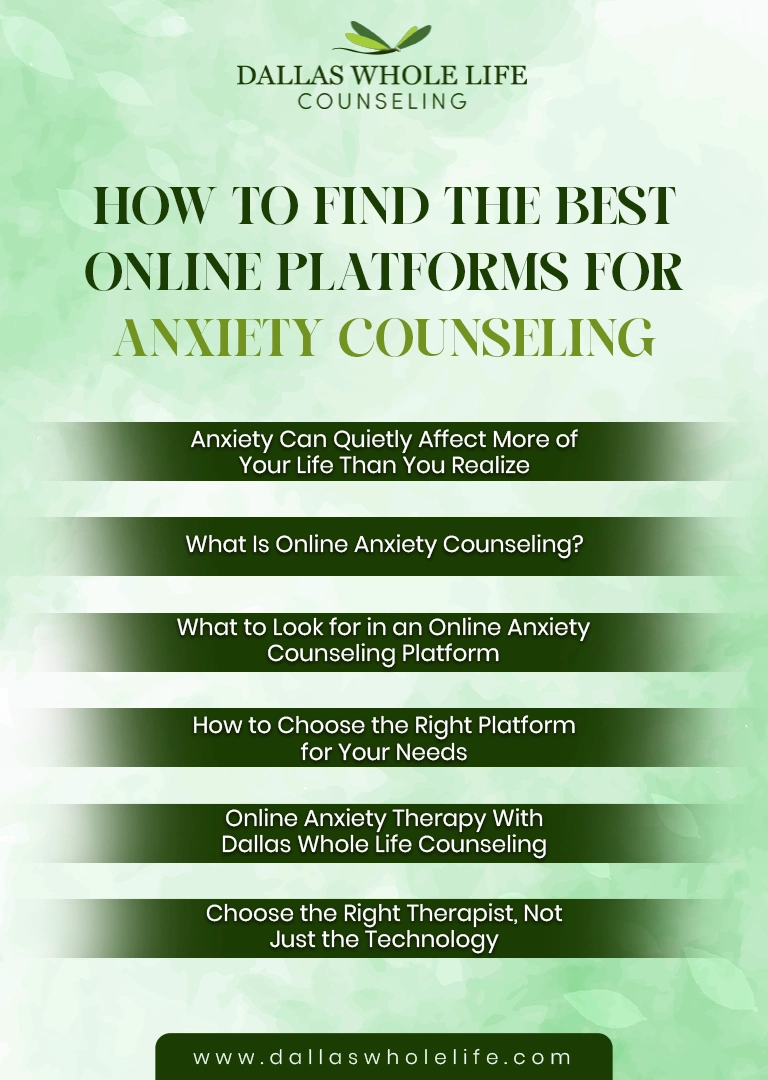
Anxiety Can Quietly Affect More of Your Life Than You Realize
Anxiety does not always appear as intense fear or panic. It can develop gradually and become part of your normal routine before you recognize how much it is affecting you.
You may still work, study, and manage daily responsibilities while privately dealing with constant worry, irritability, poor sleep, or physical tension. Online counseling can provide a practical way to address these symptoms without adding travel and waiting-room stress.
How Anxiety Affects Daily Life, Work, and Relationships
Anxiety can influence how you think, behave, and respond to other people.
You may notice that you:
- Replay conversations repeatedly
- Expect situations to turn out badly.
- Avoid decisions because you fear making a mistake.
- Struggle to concentrate at work
- Feel exhausted despite getting enough rest
- Become impatient with people close to you
- Avoid social plans
- Seek reassurance repeatedly
- Have difficulty switching off at night
These patterns may initially seem manageable, but they can gradually limit your choices and affect your well-being.
When Worry May Be More Than Everyday Stress
Stress often relates to an identifiable pressure, such as an upcoming deadline or financial concern. It may ease when the situation improves.
Anxiety may continue even when there is no immediate problem to solve. It can feel difficult to control and may cause emotional, behavioral, and physical symptoms.
Anxiety disorders can involve fear or worry that is out of proportion to the situation and interferes with daily life. Common types include generalized anxiety disorder, social anxiety disorder, panic disorder, and specific phobias.
Common Myths About Anxiety
Many people delay support because they believe the following:
- “It is only stress.”
- “Other people have bigger problems.”
- “I should be able to handle this alone.”
- “Therapy is only for severe mental health conditions.”
- “Talking about anxiety will make it worse.”
- “Online counseling is not real therapy.”
Anxiety is treatable, and seeking support does not mean you lack strength or independence.
How Online Counseling Removes Common Barriers
Online counseling allows you to meet with a therapist by secure video or another approved communication method.
This may reduce barriers such as the following:
- Travel time
- Parking
- Living far from a suitable therapist
- Limited appointment availability nearby
- Physical mobility concerns
- Discomfort in waiting rooms
- Difficulty fitting sessions around work or family
The US Department of Health and Human Services states that behavioral telehealth may improve access, privacy, convenience, and continuity of care while reducing barriers associated with travel and stigma.
Why Early Support Can Make Anxiety Easier to Manage
Anxiety often becomes stronger through avoidance.
Avoiding a meeting, journey, or social situation may reduce discomfort temporarily. However, it can also teach your brain that the situation was dangerous and that avoidance was necessary.
Therapy can help you identify this cycle and begin making changes before anxiety affects more areas of your life.
What Is Online Anxiety Counseling?
Online anxiety counseling is professional mental health treatment delivered remotely, most commonly through live video sessions.
A therapist helps you understand the thoughts, behaviors, triggers, and physical responses that maintain anxiety. Treatment may include discussion, structured exercises, and skills to practice between appointments.
Signs You May Benefit From Online Therapy
Consider speaking with a therapist when anxiety:
- Feels difficult to control
- Interferes with sleep
- Affects work or school
- Creates conflict in relationships
- Causes repeated avoidance
- Leads to frequent reassurance-seeking
- Produces distressing physical symptoms
- Prevents you from doing things that matter to you
- Continues despite attempts to manage it alone
You do not need to identify the exact type of anxiety before scheduling an appointment.
Dallas Whole Life provides anxiety counseling for Texas clients who have an anxiety diagnosis or believe they may be experiencing anxiety.
Occasional Anxiety vs. an Anxiety Disorder
Occasional anxiety is a normal response to uncertainty or pressure. It becomes more concerning when its intensity, frequency, or duration does not match the situation.
A licensed therapist can assess the following:
- How long symptoms have been present
- How frequently they occur
- Which situations trigger them
- How they affect daily functioning
- Whether another mental or physical health concern may be involved
An app quiz may help you reflect on symptoms, but it cannot replace a professional assessment.
Why Online Therapy Can Feel More Comfortable
Attending from a familiar setting may make it easier to begin therapy, particularly if leaving home, traveling, or entering unfamiliar places increases your anxiety.
Online sessions can also make it easier to attend consistently.
However, therapy should still help you approach parts of life that anxiety has led you to avoid. Convenience should support treatment rather than become another way to remain permanently inside your comfort zone.
Evidence-Based Treatment for Anxiety
One of the most widely used approaches is cognitive behavioral therapy, or CBT.
CBT helps you recognize anxious thinking, question unhelpful predictions, and change behaviors that maintain anxiety. Other approaches may include acceptance and commitment therapy, mindfulness-based treatment, and exposure-based strategies.
Research reviews have found that internet-delivered CBT can reduce symptoms of anxiety and depression. Results vary according to the condition, program, and level of therapist involvement, so it remains important to choose clinically appropriate care.
What to Look for in an Online Anxiety Counseling Platform
A polished website does not prove that a platform provides suitable mental health care.
Before registering, look beyond promotional claims and examine who provides the treatment, how your information is protected, and what happens if your therapist is not the right fit.
Licensed Therapists
Confirm that treatment is provided by a licensed mental health professional rather than a coach or general support worker.
Depending on the service, providers may include the following:
- Licensed professional counselors
- Licensed clinical social workers
- Marriage and family therapists
- Psychologists
- Psychiatrists
- Other qualified prescribers
You should be able to see the therapist’s full name, credentials, and state license information.
A therapist generally needs to be authorized to treat clients in the state where the client is physically located during the session.
Experience Treating Anxiety
A therapist may be licensed but have limited experience with your particular concern.
Ask whether the therapist regularly treats:
- Generalized anxiety
- Panic attacks
- Social anxiety
- Health anxiety
- Phobias
- Obsessive thoughts or compulsions
- Work or performance anxiety
- Anxiety alongside depression
It is also helpful to ask which treatment methods they use.
HIPAA and Privacy Practices
Do not rely only on a platform stating that it is “secure.”
Review its privacy information and ask:
- Which technology is used for sessions?
- How are records stored?
- Who can access your information?
- Is session content recorded?
- How are messages handled?
- What happens if there is a data breach?
- Can your information be used for advertising?
Covered healthcare providers offering telehealth must comply with applicable HIPAA requirements. The US Department of Health and Human Services provides guidance about privacy and security when remote communication technology is used for healthcare.
Transparent Pricing
A suitable platform should make its costs reasonably clear before you enter payment information.
Check for:
- Price per appointment
- Subscription charges
- Initial assessment fees
- Insurance co-payments
- Deductibles
- Cancellation charges
- Missed-session fees
- Medication management costs
- Automatic renewal terms
A low advertised weekly price may not include live video therapy, so check exactly what the plan provides.
Communication Methods
Online services may offer:
- Live video sessions
- Telephone sessions
- Live text chat
- Asynchronous messaging
- Worksheets or exercises
- Group sessions
These formats are not interchangeable.
Live video allows a fuller clinical conversation and gives the therapist more information about tone and non-verbal communication. Messaging may help you record thoughts between sessions, but it may not provide the depth or immediate interaction of scheduled therapy.
Video, Phone, Chat, or Messaging
The best format depends on your needs, but live sessions are often the clearest starting point for assessing anxiety and developing a treatment plan.
Video may suit you when:
- You want real-time conversation
- Facial expressions and body language help communication.
- You need structured appointments.
- You want an experience closer to office-based therapy.
A phone may suit you when:
- Your internet connection is unreliable.
- Video increases discomfort
- You have a private place to speak but not to appear on camera.
Messaging may suit you when:
- You want to record experiences between sessions
- Writing helps organize your thoughts.
- It supplements rather than replaces live care
Ask how often the therapist reads and responds to messages. “Unlimited messaging” does not always mean immediate or daily replies.
Anxiety-Focused vs. General Therapy Platforms
An anxiety-focused service may provide therapists, assessments, and exercises designed around anxiety conditions.
A general therapy platform may offer a wider range of professionals and treatment approaches.
Neither option is automatically better. The important question is whether the individual therapist has suitable experience and offers a treatment method supported for your concern.
Insurance-Based vs. Self-Pay Services
Insurance may reduce your session cost, but it can also limit which therapists you can choose.
Before selecting an insurance-based platform, confirm:
- Whether the platform is in-network
- Whether the individual therapist is in-network
- Your co-payment
- Your remaining deductible
- Whether virtual mental health care is covered
- Whether pre-authorization is needed
Self-pay services may offer more choice and simpler billing, but you will need to compare the full cost carefully.
Therapist Matching and Switching
Some platforms select a therapist based on a questionnaire. Others allow you to review profiles and choose.
A useful matching process should consider:
- Your symptoms
- Preferred treatment style
- Availability
- Therapist experience
- Identity or cultural preferences
- Insurance
- Communication format
Check whether switching therapists is easy, whether there is an additional charge, and how quickly another appointment can be arranged.
Features That May Support Anxiety Treatment
Extra tools can be useful when they support a therapist-led treatment plan.
Helpful features may include:
- Thought records
- Mood or symptom tracking
- Guided journaling
- CBT worksheets
- Appointment reminders
- Secure between-session messaging
- Exposure planning
- Relaxation or grounding exercises
- Progress reviews
These tools should support treatment rather than distract from the quality of the therapist.
Medication Management
Some platforms provide therapy only, while others also offer appointments with a psychiatrist or another qualified prescriber.
Medication support may be useful when symptoms are severe, persistent, or significantly affect daily functioning.
Before choosing a combined platform, ask:
- Who completes the medication evaluation?
- How frequently are follow-up appointments held?
- How are side effects monitored?
- How does the prescriber communicate with the therapist?
- What happens if you need help between appointments?
- Which medications cannot be prescribed through the platform?
Medication decisions should be based on an individual clinical assessment.

How to Choose the Right Platform for Your Needs
There is no universal ranking that can identify the right service for every person.
A platform that suits someone with mild work-related anxiety may not be suitable for someone experiencing frequent panic attacks, complex trauma, or symptoms that require coordinated medical care.
Start With Your Main Need
Before comparing platforms, write down what you want help with.
For example:
- I cannot stop worrying.
- I avoid social situations.
- I experience panic attacks.
- I am constantly worried about my health.
- Work pressure is affecting my sleep.
- I need therapy and a medication evaluation.
- I need evening appointments.
- I want a therapist experienced in CBT.
This makes it easier to remove services that do not meet your basic requirements.
Set a Realistic Budget
Consider the total monthly cost rather than only the price of one session.
Your budget may need to cover:
- Initial assessment
- Weekly or fortnightly therapy
- Subscription fees
- Psychiatry appointments
- Medication
- Missed-session costs
- Insurance deductibles
Do not assume that the cheapest platform provides the best value. Inconsistent care or repeatedly changing therapists may make a lower-priced option less useful.
Consider Symptom Severity
Online outpatient therapy may suit many people with mild to moderate anxiety and some people with more significant symptoms.
A platform may be unsuitable when you require the following:
- Intensive daily support
- Close medical monitoring
- In-person assessment
- Coordinated care involving several providers
- Services the platform does not offer
A professional consultation can help determine the appropriate level of care.
Ask Questions Before Signing Up
Useful questions include:
- Is the therapist licensed in Texas?
- Does the therapist regularly treat my type of anxiety?
- Which treatment methods do they use?
- How long is each session?
- Can I change therapists?
- How quickly can I schedule an appointment?
- Is messaging included?
- Who can view my information?
- Is the service covered by insurance?
- What is the cancellation policy?
- Will my subscription renew automatically?
- Is medication management available?
A reputable provider should answer these questions clearly.
Review Credentials Independently
Do not rely only on the platform’s therapist profile.
You can usually check a professional’s license through the relevant state licensing board. Confirm that:
- The license is active
- The name matches the provider.
- The provider is licensed in your state.
- The credentials shown are accurate.
This extra step can help you distinguish licensed therapy from coaching or informal emotional support.
Read the Cancellation and Refund Terms.
Some platforms charge a monthly subscription even when you do not schedule a session. Others charge per appointment.
Review:
- How to cancel
- How much notice is required?
- Whether unused sessions carry over
- Whether refunds are available
- What happens when a therapist cancels
- Whether changing plans affects billing
Save a copy of the terms you accepted.
Therapy Only vs. Therapy and Medication
Therapy may be a suitable starting point when anxiety is manageable and you can participate in regular sessions.
A medication evaluation may also be worth discussing when:
- Symptoms significantly affect daily functioning.
- Panic or physical anxiety is difficult to manage.
- Therapy alone has not provided enough improvement.
- Anxiety occurs alongside depression.
- A therapist or doctor recommends an assessment.
Medication is not necessary for everyone, and the decision should be made with a qualified healthcare professional.
Decide Whether the First Session Felt Useful
The first appointment does not need to solve the problem. It should help you decide whether the therapist and treatment approach feel suitable.
Ask yourself:
- Did I feel listened to?
- Did the therapist understand my main concern?
- Were their questions relevant?
- Did they explain how treatment may work?
- Did I feel respected?
- Were next steps clear?
- Could I imagine discussing difficult topics with this person?
Therapy can feel uncomfortable at times, but you should not feel dismissed, pressured, or judged.
Give Fit Enough Time, but Trust Serious Concerns
It may take more than one session to feel completely comfortable.
However, consider changing providers when the therapist:
- Regularly appears distracted
- Gives vague advice without a treatment plan
- Does not understand your condition
- Repeatedly cancels
- Pressures you into unnecessary services
- Ignores questions about credentials or privacy
- Makes you feel unsafe or disrespected
A poor first match does not mean online therapy will not work for you.
Why Reputation and Continuity Matter
A reputable platform should have clear professional standards, privacy information, and procedures for complaints or clinical concerns.
Continuity also matters. Anxiety treatment is often more productive when you can work consistently with one therapist who understands your history, goals, and progress.
Frequent provider changes may force you to repeat your story and make it harder to build trust.

Online Anxiety Therapy With Dallas Whole Life Counseling
You do not necessarily need a large national subscription platform to receive online anxiety counseling.
A local clinical practice offering virtual appointments may provide clearer information about its therapists, treatment methods, office support, and insurance arrangements.
Licensed Texas Therapists
Dallas Whole Life Counseling provides online and in-person therapy with trained, licensed professionals. Treatment options include CBT, acceptance and commitment therapy, and other approaches selected according to the client’s needs.
Anxiety-Specific Support
Our therapists work with concerns such as:
- Generalized anxiety
- Panic attacks
- Social anxiety
- Health-related worry
- Work and performance anxiety
- Stress
- Anxiety occurring alongside depression
- Avoidance and repetitive worry
You can read more about how online anxiety therapy works before scheduling.
Virtual Appointments Across Texas
Online sessions allow Texas clients to receive care from a private location without traveling to Dallas.
Availability depends on the therapist, your needs, and where you are physically located at the time of the appointment.
In-Person and Online Options
Some people prefer to begin online and later attend in person. Others want to continue virtually because it fits their routine.
Having both options available may provide greater continuity when work, travel, or family responsibilities change.

Choose the Right Therapist, Not Just the Technology
The best online anxiety counseling platform is not necessarily the one with the most advertisements, worksheets, or subscription choices.
Look first at the therapist’s qualifications, anxiety experience, and treatment approach. Then consider cost, privacy, insurance, appointment times, and communication options.
A secure video platform is simply the setting. The quality of care depends on the professional relationship, the treatment plan, and your ability to participate consistently.
Dallas Whole Life Counseling offers online anxiety therapy with licensed professionals for clients across Texas.
Frequently Asked Questions
How Do I Know Whether an Online Therapy Platform Is Legitimate?
Check that therapists are licensed in your state, credentials can be independently verified, pricing is clear, and the service explains how it protects personal health information. Avoid platforms that hide provider identities or make unrealistic promises.
Are Online Therapists Licensed and Qualified?
Many are, but not every person offering emotional support online is a licensed therapist. Review the provider’s full name, credentials, state license, and professional experience before beginning treatment.
Is Online Counselling Effective for Anxiety?
Research supports online therapy, particularly therapist-supported CBT, for many anxiety concerns. Its effectiveness depends on the condition, treatment approach, therapist involvement, and suitability for the individual.
Is Video, Chat, or Messaging Better for Anxiety?
Live video often provides the most complete therapy experience because it allows real-time conversation and non-verbal communication. Phone or messaging may also be useful, depending on your preferences and whether they are part of a structured treatment plan.
Can I Use Insurance for Online Anxiety Counseling?
Many insurers cover virtual mental health appointments, but coverage varies. Confirm that both the platform and therapist are in-network and ask about deductibles, co-payments, and pre-authorization.
How Much Does Online Anxiety Therapy Cost?
Costs vary according to the provider, session length, insurance, and whether the service charges per appointment or by subscription. Review the total expected monthly cost and any separate assessment or medication charges.
Can I Switch Therapists?
Most services allow therapist changes, but the process and availability vary. Check whether switching costs extra and how quickly another qualified therapist can see you.
Is My Information Private?
Licensed healthcare providers must follow applicable privacy requirements, but practices vary between services. Read the privacy policy and ask how video, records, and messages are protected.
What If My Anxiety Feels Severe?
Contact a licensed healthcare professional for an assessment rather than relying only on self-guided tools or messaging. They can help determine whether standard online therapy, medication support, in-person care, or another level of treatment is appropriate.
