

Grief during the holidays often feels heavier because the season is full of traditions, reminders, and empty spaces. You can cope by planning ahead, keeping only the traditions that feel right, setting limits, honoring who or what you’ve lost, and asking for help. If grief feels too heavy to carry, grief counseling in Dallas can support you.
Grief during the holidays can catch you off guard, even if you’ve been doing okay for weeks. A song, a recipe, an empty chair at the table, and the day tips. If that’s where you are this season, here are gentle ways to get through it and signs that it may be time to talk to someone.
Why Grief Can Feel Heavier During The Holidays

The holidays are built around togetherness and tradition, which makes an absence easier to see. Mayo Clinic notes that grief can be heightened and may feel overwhelming at this time of year, whether the loss was recent or happened a while ago. A few things tend to stack up:
- Reminders everywhere. Songs, smells, decorations, and the dish only they could make.
- Traditions that were theirs. Who carves the turkey now? Who hangs the last ornament?
- Pressure to be cheerful. Everyone around you seems fine, and you’re not.
- Shorter, darker days. Less light can weigh on anyone’s mood, and seasonal changes in mood can pile onto grief.
- No finish line. You may have heard of the 5 stages of grief, but many people find grief doesn’t move in a straight line. A feeling you thought had passed can return in December.
None of this means you’re doing grief wrong. It means this season is hard.
Grief Goes Beyond Losing Someone

Loss takes many forms, and the holidays can bring any of them to the surface. You might be grieving:
- A divorce or the end of a relationship.
- A relationship with a parent, sibling, or child who is no longer in your life.
- A pregnancy loss, whether recent or years ago.
- A first holiday apart from someone you love, because of a move, a separation, or a changed family.
- A pet.
- A different life than the one you pictured, such as a health change or a job loss.
If your loss isn’t the kind people send cards for, it still counts. You don’t need anyone’s permission to feel it.
Ways To Cope This Season

There’s no right way to get through the holidays while grieving. These five steps give you something to hold onto. Coping with grief during the holidays tends to go better when you decide things ahead of time rather than in the moment.
- Plan ahead. Think through the hard parts before they arrive. Who will be there? Where will you sit? What will you do if it gets to be too much? Having a plan, even a loose one, takes some of the surprise out of the day.
- Choose which traditions to keep. You don’t have to do everything the way you always have. Keep the ones that bring comfort, change the ones that hurt, and let go of the rest, at least this year. You can bring a tradition back later.
- Set limits. It’s okay to say no to a party, leave early, or drive separately so you can go when you need to. Protect your energy as if it were a limited supply, because right now it may be.
- Honor the person or the loss. Light a candle, set a place at the table, cook their favorite meal, tell a story about them, or write them a letter. Mayo Clinic suggests that finding ways to remember loved ones can help restore a sense of balance. Honoring your grief can sit alongside the holiday rather than compete with it.
- Ask for help. Tell one person how you’re really doing. Ask someone to handle a task that feels like too much. And if you’d like support from someone trained in grief, that’s a reasonable thing to reach for now, not only later.
How To Support A Grieving Family Member
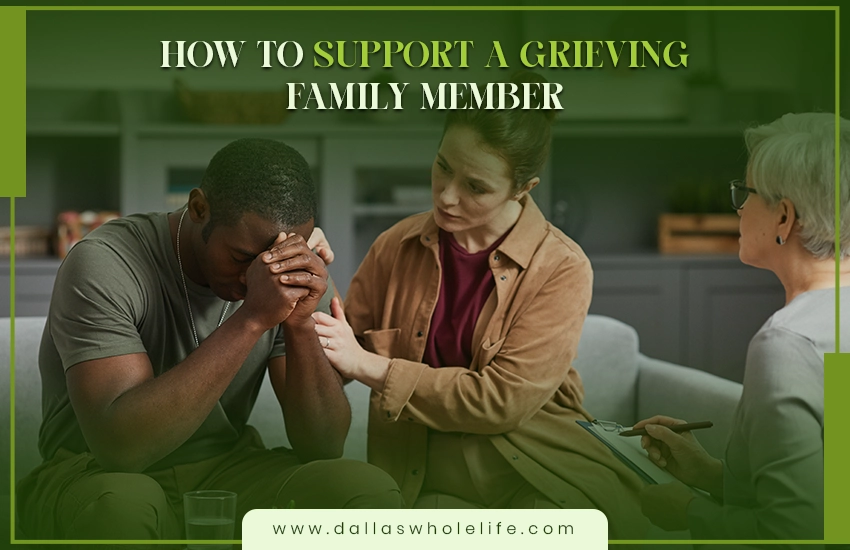
If someone close to you is hurting this season, you may be worried about saying the wrong thing. You don’t need perfect words. Showing up counts for more than saying it exactly right.
What helps
- Say their name. Mentioning the person who died tells your family member they’re not forgotten.
- Invite without pressure. Make it easy to say no, and ask again next time.
- Offer something specific. “Can I pick up groceries Thursday?” works better than “Let me know if you need anything.”
- Listen more than you fix. You don’t have to solve their sadness. Sitting with it is enough.
What to skip
- Phrases like “at least they’re in a better place” or “everything happens for a reason.” Even when well-meant, they can sound like you’re hurrying the grief along.
- Assuming they want distraction. Some people do, and some don’t. Ask.
- Expecting them to be “over it” by a certain date.
When Grief May Need More Support

Grief is not a problem to be fixed. It’s a response to loss, and it can be heavy for a long time. Still, sometimes it’s worth reaching out for more help. The Hospice Foundation of America notes that grief experts generally suggest seeking support if grief feels unmanageable or if you haven’t returned to your usual level of functioning six to 12 months after a loss. You can reach out sooner than that, too.
You might notice:
- Sorrow or longing that isn’t easing and keeps getting in the way of daily life.
- Trouble sleeping, eating, or getting out of bed most days.
- Feeling numb or cut off from people you care about.
- Avoiding anything that reminds you of the loss until your life keeps shrinking.
- Guilt or self-blame that you can’t shake.
- Thoughts that life isn’t worth living. If this is you, reach out right away. The note below tells you how.
Having some of these doesn’t mean something is wrong with you. It means you may be carrying more than you can carry alone.
Grief Counseling in Dallas, In-Person Or Online
Grief counseling isn’t about getting you to move on. It’s a place to talk about the person or the loss, make sense of what has changed, and find ways to get through days like the ones coming up. Our grief counseling in Dallas is built around that, and grief and loss therapy can fit into your schedule whether the holidays are weeks away or already here.
You can meet our counselors and choose someone who feels right. Sessions are available in person at our Dallas office or online if you’re located in Texas. You don’t have to explain everything at the first appointment. You can start wherever you are. We accept Aetna, BCBS of Texas, Cigna, Medicare, United Healthcare, UMR, and Optum, plus private pay.
Call or text 988 (Suicide & Crisis Lifeline). If you’re in immediate danger, call 911.
Frequently Asked Questions
Is it normal not to want to celebrate?
Yes. Many grieving people want to skip, scale back, or do things differently. Mixed feelings are common too, like laughing at dinner and crying in the car afterward. Neither means you didn’t love them.
How do I get through the first holiday after a loss?
Lower the bar. Decide in advance what “good enough” looks like, keep the day small, and have one person you can text if it gets hard. Let the day be what it is. It doesn’t have to be a good one to be a day you got through.
When should I see a grief counselor?
Whenever you’d like support. You don’t have to wait until things get worse. Counselors also work with people early in grief, when the shock is still fresh, and everything feels unfamiliar.
Can grief counseling be done online?
Yes. Many people find it easier on heavy days to talk from home, without having to get dressed, drive, and keep it together on the way. If you’d rather sit in the room with someone, that’s an option too.
