

Life coaching can improve emotional intelligence by helping you recognize your emotions, understand what triggers them, and choose more useful ways to respond. Through guided reflection, goal-setting, and practical exercises, coaching can strengthen self-awareness, emotional regulation, motivation, empathy, and social skills. At Dallas Whole Life Counseling, life coaching is available in person in Dallas and virtually across Texas.
You may be intelligent, capable, and successful, yet still struggle with conflict, criticism, or emotional pressure.
Perhaps you react before thinking, find it difficult to explain how you feel, or repeatedly misunderstand the people around you. These challenges are not necessarily caused by a lack of effort or good intentions. They may point to emotional skills that have not been fully developed.
Emotional intelligence can grow with awareness and practice. Life coaching provides a structured way to identify your patterns, test healthier responses, and use what you learn in daily life.

Why Some Smart, Capable People Still Struggle in Relationships, Work, and Life
Academic knowledge and technical ability can help you solve problems, but they do not automatically teach you how to manage frustration, receive feedback, or understand someone else’s perspective.
Emotional intelligence shapes how you respond when situations become uncomfortable. It influences your relationships, decisions, leadership style, and ability to recover after setbacks.
What Is Emotional Intelligence and How Is It Different From IQ?
Emotional intelligence, often called EQ or EI, refers to a group of abilities involving emotions.
These include being able to:
- Recognize what you are feeling
- Understand why you feel that way
- Manage emotional reactions
- Notice emotions in other people
- Communicate with awareness and empathy
- Use emotional information when making decisions
IQ generally relates to cognitive abilities such as reasoning, memory, and problem-solving. EQ relates more closely to how you understand and manage emotions in yourself and your interactions.
A person can be highly intelligent while still finding emotional situations difficult.
Who Coined Emotional Intelligence?
Psychologists Peter Salovey and John Mayer introduced a formal model of emotional intelligence in academic research during the early 1990s. Daniel Goleman later helped popularize the concept through his writing.
Goleman’s well-known framework describes emotional intelligence through five areas:
- Self-awareness
- Self-regulation
- Motivation
- Empathy
- Social skills
These areas provide a practical way to understand how emotional intelligence appears in everyday life.
The Five Core Components of Emotional Intelligence
Self-awareness means noticing and understanding your emotions, habits, and triggers.
Self-regulation means managing your response rather than acting on every emotional impulse.
Motivation involves continuing towards meaningful goals, even when progress feels difficult.
Empathy means recognizing and considering another person’s emotional experience.
Social skills involve communication, conflict management, cooperation, and relationship-building.
These components affect one another. It is easier to regulate an emotion once you can identify it, and it is easier to communicate well when you understand both your own feelings and the other person’s perspective.
Why a High IQ Does Not Guarantee Success
Knowledge may help you complete a task, but professional and personal success often requires collaboration, adaptability, and communication.
Someone may understand a complex problem yet struggle to explain it without becoming defensive. Another person may produce excellent work but respond poorly to criticism or disagreement.
Emotional intelligence helps you use your knowledge in situations involving pressure, uncertainty, and other people.
Signs Your Emotional Intelligence May Need Attention
Having difficulty in one emotional area does not mean you lack emotional intelligence altogether. Most people have strengths in some areas and gaps in others.
Possible signs include:
- Becoming defensive when receiving feedback
- Struggling to name what you are feeling
- Reacting quickly and regretting it later
- Repeating the same relationship conflicts
- Missing signs that someone is uncomfortable
- Blaming others without examining your role
- Avoiding difficult conversations
- Finding it hard to apologize
- Shutting down when emotions become intense
- Assuming your intentions matter more than your impact
Recognizing these patterns is not a reason for shame. Awareness is the starting point for changing them.
How Low Emotional Intelligence Appears in Daily Life
At work, lower EQ may look like poor communication, difficulty receiving direction, or tension with colleagues.
In relationships, it may involve emotional withdrawal, frequent misunderstandings, or arguments that never reach the real issue.
Within yourself, it may feel like confusion. You know you are upset but cannot identify whether you feel hurt, disappointed, embarrassed, frightened, or angry.
Without that clarity, it becomes harder to decide what you need or communicate it effectively.
Can Emotional Intelligence Be Developed?
Emotional intelligence is not completely fixed. Research indicates that targeted emotional intelligence programs can improve measured emotional abilities, although results vary by the type of training and the skills being assessed. A meta-analysis published in Human Resource Management Review examined whether emotional intelligence can be developed through training.
Improvement requires more than reading about emotions. It usually involves recognizing patterns, practicing new behaviors, and receiving feedback.
Life coaching can support this process by turning broad advice into specific actions connected to your daily experiences.

The Real Cost of Low Emotional Intelligence
Emotional habits affect far more than isolated disagreements. They can influence your well-being, career, relationships, and the way you view yourself.
When you cannot identify or manage what you feel, you may repeat reactions that provide temporary relief but create longer-term problems.
How Low Self-Awareness Keeps You Stuck
You cannot change a pattern you do not recognize.
For example, you may think other people are overly critical without noticing that you become defensive whenever feedback is offered. You may believe every relationship ends for unrelated reasons while missing a repeated pattern of emotional withdrawal.
Life coaching helps you slow these experiences down and ask:
- What happened?
- What did I feel?
- What meaning did I give the situation?
- How did I respond?
- What effect did that response have?
- What could I do differently next time?
These questions turn vague frustration into something you can understand and address.
What Poor Self-Regulation Looks Like
Self-regulation does not mean suppressing emotions or pretending everything is fine. It means choosing how and when to express what you feel.
Difficulties with regulation may appear as the following:
- Emotional outbursts
- Sending messages while angry
- Avoiding people after conflict
- Shutting down during difficult conversations
- Making impulsive decisions
- Dwelling on criticism for days
- Using distraction to avoid every uncomfortable feeling
The goal is not to become emotionless. It is to respond in a way that reflects your values rather than the strongest feeling of the moment.
How Low Empathy Damages Relationships
You can care about someone and still struggle to understand their emotional experience.
Low empathy may cause you to offer solutions when someone needs to be heard, dismiss a reaction you do not understand, or focus only on whether you meant to cause harm.
Empathy asks you to consider impact as well as intention.
Research also shows that empathy and emotional regulation are related but distinct abilities. Understanding another person’s feelings does not automatically mean you can manage your own response to them. A meta-analytic review explored the relationship between empathy, sympathy, and emotion regulation.
Emotional Intelligence and Leadership
A manager’s emotions can affect an entire team.
Leaders with limited emotional awareness may communicate frustration through tone, avoid giving necessary feedback, or react defensively when employees raise concerns.
Emotionally intelligent leadership includes the following:
- Listening before responding
- Communicating expectations clearly
- Remaining steady under pressure
- Recognizing how decisions affect people
- Managing disagreement without becoming personal
- Admitting mistakes
- Giving feedback with respect
These behaviors can help create greater trust and clearer communication.
Emotional Intelligence in Relationships
Partners do not always experience or express emotion in the same way.
One person may want to discuss a problem immediately, while the other needs time to process it. One may express care through words, while the other relies more on actions.
These differences do not automatically mean the relationship is incompatible. Problems develop when partners assume their own emotional style is the only correct one.
Improving EQ can help each person communicate needs more clearly and become more curious about the other person’s experience.
Emotional Intelligence, Anxiety, and Depression
Emotional intelligence does not prevent every mental health condition. Anxiety and depression involve factors that cannot be reduced to emotional skills alone.
However, difficulty identifying and managing emotions may make symptoms harder to understand or discuss.
For example, someone experiencing anxiety may describe themselves only as stressed. A person experiencing depression may recognize irritability but not the sadness, exhaustion, or hopelessness beneath it.
Therapy may be more appropriate when emotional difficulties involve persistent distress, mental health symptoms, or reduced daily functioning.
How Childhood Experiences Shape Emotional Intelligence
Families teach emotional skills both directly and indirectly.
If emotions were discussed openly, you may have learned how to name feelings and ask for support. If emotions were criticized, ignored, or treated as dangerous, you may have learned to hide them.
You may also have copied the communication and conflict styles modeled by caregivers.
These early experiences can influence emotional habits, but they do not have to define how you respond for the rest of your life.
Can Stress and Trauma Affect Emotional Intelligence?
Long-term stress can make it harder to pause, listen, and think clearly. When the nervous system remains focused on possible danger, reactions may become quicker and stronger.
Trauma may also affect trust, emotional awareness, and the ability to feel safe during conflict.
Life coaching may help with present-focused goals and skills. However, trauma-related symptoms often need treatment from a qualified therapist rather than coaching alone.
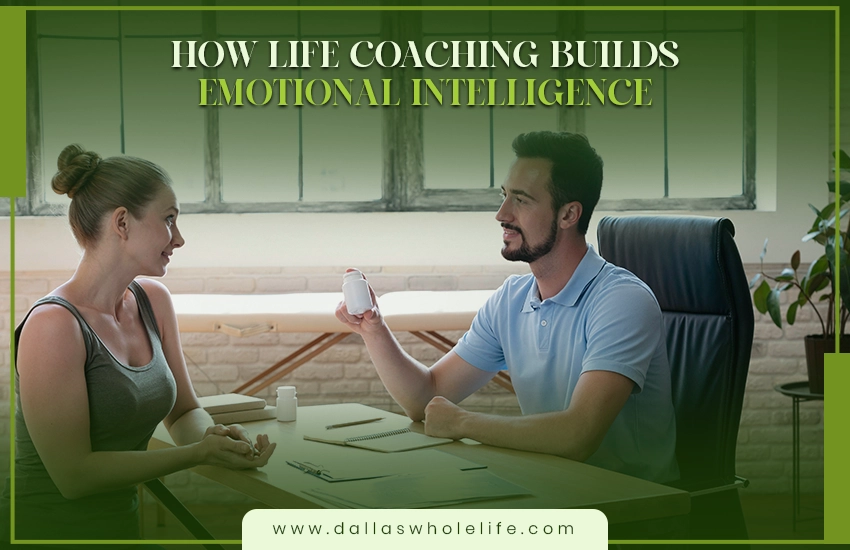
How Life Coaching Builds Emotional Intelligence
Emotional intelligence improves when insight is connected to repeated practice.
Life coaching helps you identify a specific emotional pattern, understand how it affects your life, and develop a realistic way to respond differently.
What Is Life Coaching?
Life coaching is a goal-focused process that supports personal or professional development.
You may work with a life coach to improve the following:
- Confidence
- Communication
- Relationships
- Work-life balance
- Decision-making
- Personal direction
- Emotional awareness
- Motivation
- Accountability
At Dallas Whole Life Counseling, life coaching focuses on helping clients understand obstacles and take practical steps towards meaningful goals.
Life Coaching vs. Therapy for Emotional Intelligence
Life coaching generally focuses on current patterns, future goals, and skill development. Therapy can address mental health symptoms, emotional distress, trauma, and experiences from the past.
Life coaching may suit you when
- You function well but want to grow
- You have a clear goal.
- You want greater accountability
- You need help practicing communication.
- You want to strengthen emotional habits.
Therapy may be more suitable when:
- Anxiety or depression affects daily functioning
- Past trauma is driving current reactions.
- Emotions feel overwhelming or unsafe
- You are experiencing a mental health crisis
- Relationship patterns involve abuse or serious instability.
Some people benefit from coaching and therapy at different times or alongside one another.
How Life Coaching Builds Self-Awareness
A coach helps you pay attention to patterns that are easy to miss when you are moving quickly through daily life.
You may explore:
- Situations that trigger strong reactions
- Physical signals that appear before an emotion
- Thoughts that shape your interpretation
- Habits used to avoid discomfort
- Values that influence your choices
- Differences between your intentions and impact
Greater self-awareness allows you to recognize a reaction earlier, when you still have more choice about what happens next.
How Life Coaching Improves Self-Regulation
A coach may help you create a pause between feeling and action.
This may involve learning to:
- Notice the emotional trigger
- Name the emotion accurately.
- Recognize the urge it creates
- Consider the likely consequences.
- Choose a response that supports your goal.
You may also practice grounding, breathing, reframing, or communication strategies.
Self-regulation is not about avoiding emotion. It is about staying in control of your behavior while allowing the emotion to exist.
How Life Coaching Develops Empathy
Empathy becomes stronger when you learn to listen without immediately preparing a reply.
A coach may help you practice asking questions such as
- What might this situation feel like for the other person?
- What have I assumed without checking?
- What emotion could be behind their behavior?
- What do they need me to understand?
- Can I acknowledge their experience without agreeing with every conclusion?
Empathy does not require you to abandon your own needs or boundaries. It allows you to consider more than one perspective at the same time.
How Coaching Strengthens Social Skills
Social skills include far more than being outgoing.
They involve being able to communicate clearly, respond to social cues, manage disagreements, and create mutual understanding.
Coaching may help you work on:
- Active listening
- Assertiveness
- Boundary-setting
- Giving and receiving feedback
- Expressing emotions clearly
- Resolving conflict
- Apologizing meaningfully
- Asking for what you need
- Adjusting your communication style
These skills can improve workplace interactions, friendships, family relationships, and romantic partnerships.
How Goal-Setting Builds Motivation and Resilience
Motivation is easier to maintain when a goal has personal meaning and a clear next step.
A coach helps you move from a broad intention such as “I want to handle conflict better” to a measurable action such as “I will pause and ask one clarifying question before defending my position.”
Progress may be reviewed between sessions. When something does not work, you examine what happened and adjust the strategy.
This process builds resilience by teaching you to treat setbacks as information rather than proof that change is impossible.
What Happens in an EQ-Focused Coaching Session?
An emotional intelligence coaching session usually connects a recent experience with a wider goal.
You might discuss a disagreement, a stressful meeting, or a decision you regret. Your coach may help you identify the following:
- The emotion you experienced
- The belief behind it
- How you expressed or avoided it
- How the other person responded
- What outcome you wanted
- Which alternative response may have worked better?
You may then practice the conversation or agree on a small action to test before the next session.
How Long Does It Take to Improve Emotional Intelligence?
There is no fixed timeline.
Some clients notice increased awareness within the first few sessions. Changing a long-standing reaction may take longer because the new response needs to be practiced in different situations.
Progress also depends on:
- Your goals
- The complexity of the pattern
- How often you attend coaching
- Whether you practice between sessions
- Stress or mental health concerns
- Your willingness to receive feedback
The aim is not emotional perfection. It is steady improvement in how you understand and respond to emotional situations.
Can Life Coaching and Therapy Work Together?
Yes, when each service has a clear purpose.
Therapy might help you understand anxiety, trauma, or relationship patterns. Coaching could then support a practical goal such as communicating more assertively at work.
It is important that the professionals involved understand their roles and that coaching does not replace treatment for a mental health condition.
What Makes Dallas Whole Life’s Coaches Different?
Many Dallas Whole Life coaches are also licensed counselors or psychologists. This means they understand both goal-focused coaching and the psychological factors that can affect emotional development.
They can help you work towards practical goals while recognizing when anxiety, depression, trauma, or another issue may need a therapeutic approach.
This allows the support to reflect the whole person rather than focusing only on surface-level performance.

Life Coaching for Emotional Intelligence at Dallas Whole Life
Emotional intelligence does not have one universal starting point.
You may want to communicate more effectively at work, handle relationship conflict, or understand your own reactions. We tailor the coaching process around the situations that matter in your life.
Licensed Professionals With Coaching Experience
Dallas Whole Life brings together therapists, psychologists, and coaches who support personal, emotional, and professional concerns.
Working with a professional who understands psychology can be particularly useful when you are unsure whether your challenge is a coaching goal or a mental health concern.
Coaching Based on Your Specific Goals
Your coaching plan may focus on:
- Recognizing emotional triggers
- Remaining calm during conflict
- Communicating needs
- Understanding other perspectives
- Setting boundaries
- Becoming a more aware leader
- Managing criticism
- Improving relationship communication
- Following through on personal goals
Your coach can help turn these broad aims into behaviors you can practice and review.
Emotional Intelligence in the Workplace
EQ coaching can help managers, professionals, and business owners understand how their emotional habits affect other people.
Sessions may address:
- Leadership communication
- Team conflict
- Difficult feedback
- Workplace boundaries
- Emotional decision-making
- Managing pressure
- Listening skills
- Professional relationships
You may also consider career coaching when your main goals involve professional direction, interviews, or career advancement.
Emotional Intelligence in Relationships
Life coaching can help you understand your own communication and emotional patterns.
You may learn to:
- Express needs without blame
- Listen without interrupting
- Notice when you become defensive
- Discuss problems before resentment builds
- Validate another person’s experience
- Remain present during uncomfortable conversations
When the main concern involves ongoing relationship distress, couples counseling or individual therapy may be recommended instead.
Online Life Coaching Across Texas
Dallas Whole Life provides virtual counseling and coaching for clients across Texas, as well as in-person appointments in Dallas.
Online coaching allows you to attend from a private setting without adding travel time to your schedule. You still receive live, individual support and can discuss real situations as they arise.
Evening and Weekend Sessions
Evening and weekend appointments may be available for clients managing demanding work, study, or family schedules.
Availability varies by coach, so contact the office to discuss current options and the type of support you are looking for.
Insurance and Payment Options
Dallas Whole Life accepts several insurance plans and provides self-pay options. Coverage depends on your plan, provider, and the nature of the service.
Insurance may not cover coaching when it is not considered mental health treatment. The office can help you understand available payment arrangements before you book.
How to Begin Life Coaching
You do not need to know exactly which emotional intelligence skill needs improvement before your first appointment.
You can begin by describing:
- A situation you keep struggling with
- A reaction you want to change
- A relationship you want to improve
- A goal you cannot seem to follow through on
- The way you want to feel or behave differently
Your coach can help you clarify the goal and determine whether coaching is the right service.

Better Emotional Skills Can Change More Than One Part of Your Life
The most capable person in the room is not always the one with the highest qualifications. Often, it is the person who can understand their emotions, stay grounded under pressure, and connect effectively with others.
These abilities are not reserved for people who developed them naturally. Emotional intelligence can improve through honest reflection, guided practice, and consistent action.
At Dallas Whole Life Counseling, our life coaches help clients turn emotional awareness into practical changes at work, in relationships, and throughout daily life. Sessions are available in person in Dallas and virtually across Texas.
Frequently Asked Questions
What Is Emotional Intelligence and Why Does It Matter?
Emotional intelligence is the ability to recognize, understand, and manage emotions in yourself while responding thoughtfully to emotions in other people. It affects communication, relationships, decisions, and resilience.
What Are the Five Components of Emotional Intelligence?
Daniel Goleman’s framework identifies self-awareness, self-regulation, motivation, empathy, and social skills as five major components of emotional intelligence.
Can Emotional Intelligence Be Learned?
Yes. Emotional skills can be strengthened through awareness, practice, feedback, and structured training. The amount of improvement and time required vary between individuals.
What Are the Signs of Lower Emotional Intelligence?
Signs may include defensiveness, impulsive reactions, difficulty naming emotions, repeated conflict, poor listening, and limited awareness of how your behavior affects others.
How Does Low EQ Affect Work and Relationships?
It may contribute to misunderstandings, unresolved conflict, poor leadership, difficulty receiving feedback, and emotional distance in relationships.
What Is the Difference Between Coaching and Therapy for EQ?
Coaching focuses on goals, current behavior, and skill development. Therapy can address mental health symptoms, trauma, emotional distress, and deeper patterns from the past.
How Does Life Coaching Improve Emotional Intelligence?
Life coaching helps you recognize triggers, understand emotional patterns, practice regulation, develop empathy, and communicate more clearly in real situations.
How Long Does It Take to Develop Emotional Intelligence?
Some people notice greater awareness within several sessions, while changing established reactions may take longer. Consistent practice between sessions is important.
Can Coaching and Therapy Be Used Together?
Yes. Therapy can address mental health or past experiences, while coaching supports specific goals and practical skill development.
What Makes Dallas Whole Life Coaches Different?
Many Dallas Whole Life coaches are also licensed mental health professionals. They can support goal development while recognizing when therapy may be more appropriate.
Is Online EQ Coaching Available Across Texas?
Yes. Dallas Whole Life offers virtual coaching to clients across Texas, subject to coach availability and service suitability.
Can Life Coaching Improve Leadership Skills?
Yes. Coaching can strengthen emotional awareness, communication, feedback, conflict management, and the ability to remain steady under pressure.
Are Evening and Weekend Sessions Available?
Evening and weekend sessions may be available. Appointment times vary between coaches.
Does Insurance Cover Life Coaching?
Insurance coverage varies. Coaching may not be covered unless the service meets your plan’s requirements for mental health treatment. Contact the office or your insurer to confirm.
How Do I Begin Life Coaching at Dallas Whole Life?
Call (972) 755-0996 or submit an appointment request online. The team can help match you with a coach based on your goals and availability.
