

Grief and loss therapy is professional counseling that helps you process and cope with the pain of losing someone or something important to you. This could be the death of a loved one, a breakup, pregnancy loss, a serious illness, the loss of a job, or another major life change. Therapy gives you a safe place to talk openly, understand your emotions, and learn practical ways to cope while adjusting to life after loss. At Dallas Whole Life Counseling, licensed Texas therapists provide secure online grief counseling through Zoom, so you can get support from the comfort of home anywhere in Texas, including evenings and weekends.
When you are grieving, it can look like you are coping from the outside.
You answer messages.
You handle work.
You take care of the kids.
You pay bills.
You keep showing up.
But inside, it may feel very different.
You might feel numb one day and overwhelmed the next. You might cry over something small, then feel strangely calm when you think you “should” be upset. You might feel angry, guilty, anxious, exhausted, disconnected, or completely unsure what you are supposed to do with yourself now.
That is one of the hardest parts of grief. Life keeps moving, even when your inner world has changed.
Grief and loss therapy gives you somewhere to take all of that. Not just the polished version. Not just the parts that make sense. All of it.

What Is Grief and Loss Therapy?
Grief and loss therapy is counseling for people who are trying to process a painful loss.
It can help when you feel stuck, overwhelmed, isolated, guilty, angry, numb, or unable to return to daily life in the way you used to. A grief therapist does not tell you how to feel. They help you understand what you are feeling, why it may be showing up that way, and how to move through it without having to shut it down.
Grief, Loss, and Trauma: What’s the Difference?
Grief is the emotional response to losing someone or something important.
Loss is the event or change that creates the grief.
Trauma is what can happen when your nervous system experiences something as overwhelming, frightening, or unsafe.
Sometimes grief and trauma overlap. For example, losing someone suddenly, witnessing a death, receiving shocking news, or experiencing a painful medical event may leave you grieving and traumatized at the same time.
That overlap matters because traumatic grief can feel different from grief alone. You may have intrusive images, panic, nightmares, avoidance, numbness, or a feeling that your body is still bracing for danger. In those cases, support from a therapist who understands both grief and trauma can be especially important.
Dallas Whole Life Counseling also offers support for Trauma & PTSD when grief is connected to a traumatic experience.
The Stages of Grief Are Not a Checklist
You may have heard of the five stages of grief: denial, anger, bargaining, depression, and acceptance.
These stages can be useful because they give names to common grief reactions. But they are not rules. You do not have to move through them in order. You do not have to experience all of them. And reaching acceptance does not mean you never feel sadness again.
Grief is usually much messier than that.
You might feel acceptance in the morning and anger by dinner. You might feel numb for weeks, then suddenly be hit by sadness in the grocery store. You might laugh with a friend, then feel guilty for laughing.
That does not mean you are doing grief wrong. It means you are human.
The American Psychological Association says that grief can include emotional and physical distress, confusion, yearning, and worry about the future. In simple terms, grief can affect almost every part of you.
Is It Normal to Still Be Grieving Months or Years Later?
Yes. Grief does not run on a neat timeline.
Many people still feel grief months or years after a loss. Anniversaries, birthdays, holidays, songs, smells, places, photos, or family events can bring the pain back strongly.
That does not always mean something is wrong.
But it may be time to seek grief counseling if your grief still feels unbearable, if you feel unable to function, or if life feels frozen around the loss.
You might notice:
- You avoid anything that reminds you of the loss
- You feel intense guilt or blame
- You feel numb or detached most of the time
- You cannot imagine a future
- You have trouble caring for yourself
- You feel constantly anxious or on edge
- You feel like the loss just happened, even though time has passed
- You are withdrawing from people who care about you
- Your sleep, appetite, work, or relationships are seriously affected
The American Psychiatric Association describes prolonged grief disorder as intense, persistent grief that causes distress and difficulty functioning. This does not mean ordinary grief is an illness. It means some people need extra support when grief remains severe, and life feels unable to move forward.
10 Signs You May Need Grief Counseling
You do not have to wait until things feel unbearable before speaking with a therapist.
Grief counseling may help if:
- You feel like you are only surviving each day.
- You cannot talk about the loss without feeling overwhelmed.
- You avoid people, places, memories, or conversations connected to the loss.
- You feel guilty for things you did or did not do.
- You are angry and do not know where to put it.
- You feel numb, disconnected, or unlike yourself.
- You are struggling with sleep, appetite, focus, or energy.
- You feel anxious, panicked, or unsafe after the loss.
- Your relationships are being affected.
- You feel pressure to “move on,” but you know you are not okay.
You do not need to tick every box. Even one or two can be enough reason to ask for help.
How Grief Affects Your Mental Health
Grief can affect your mind, body, and behaviour.
Emotionally, you may feel sadness, anger, guilt, relief, fear, loneliness, regret, or confusion.
Mentally, you may struggle to focus, make decisions, remember things, or feel present.
Physically, grief can show up as fatigue, tightness in the chest, headaches, changes in appetite, stomach discomfort, sleep disruption, or a heavy feeling in the body.
Relationally, you may want people close one moment and need space the next. You may feel irritated when people say the wrong thing, even if they mean well.
Grief can also overlap with depression and anxiety. For example, you may feel hopeless, lose interest in things, worry constantly, or feel afraid something else bad will happen.
If grief is affecting your mood or anxiety levels, Dallas Whole Life also offers Depression Counseling and Anxiety Counseling.
Grief and Depression: How Can You Tell the Difference?
Grief and depression can look similar, but they are not always the same.
With grief, the pain often comes in waves. You may have moments of sadness, then moments where you can still connect, laugh, or feel comfort.
With depression, the heaviness may feel more constant. You might feel worthless, hopeless, emotionally flat, or unable to enjoy anything for long periods.
That said, grief can contribute to depression, and depression can make grief harder to process. You do not have to figure out the difference by yourself. A therapist can help you understand what is happening and what kind of support may fit best.
What Happens in a Grief Counseling Session?
A grief counseling session is not about forcing you to relive everything before you are ready.
The first session is usually about understanding what brought you in, what kind of loss you experienced, how it is affecting you now, and what you need support with.
You might talk about:
- What happened
- What life has been like since the loss
- What emotions feel hardest to manage
- What support you do or do not have
- How grief is affecting sleep, work, parenting, school, relationships, or daily life
- Whether trauma, anxiety, depression, guilt, or panic are part of the picture
- What you want therapy to help with
From there, your therapist may help you build coping tools, process painful memories, make sense of complicated emotions, and find ways to keep living while still honoring what you lost.
You set the pace. A good grief therapist will not rush you.
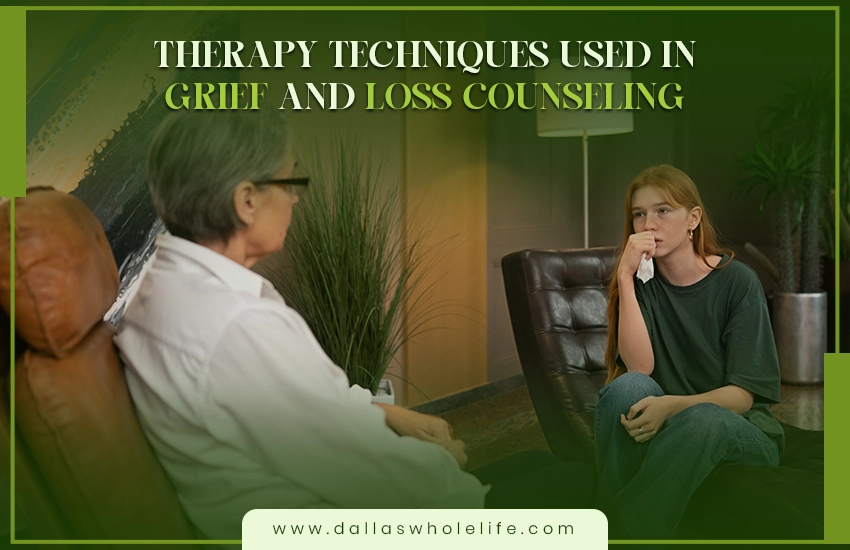
Therapy Techniques Used in Grief and Loss Counseling
Different therapists use different approaches, depending on your needs, personality, history, and type of loss.
At Dallas Whole Life Counseling, online therapy can include approaches such as cognitive-behavioral therapy, acceptance and commitment therapy, psychodynamic therapy, individual counseling, child and teen counseling, and family counseling.
In grief therapy, this may include:
Cognitive-Behavioral Therapy
CBT can help you notice painful thought patterns, such as self-blame, “I should have done more,” or “I will never feel okay again.” The goal is not to deny your pain. It is to help you relate to those thoughts in a way that is less punishing.
Acceptance and Commitment Therapy
ACT can help you make room for painful emotions without letting grief control every part of your life. It can also help you reconnect with values, relationships, and daily actions that still matter to you.
Psychodynamic Therapy
Psychodynamic therapy can help you explore the deeper meaning of the loss, your relationship history, unresolved emotions, and the way past experiences may be shaping your grief now.
Family Counseling
Loss often affects the whole family. One person may want to talk. Another may shut down. Children may show grief through behavior rather than words. Family therapy can help people communicate, support each other, and understand the different ways grief appears.

Can Online Grief Counseling Be as Effective as In-Person Therapy?
For many people, yes.
Online grief counseling allows you to speak with a licensed therapist from a private space where you feel comfortable. That can be especially helpful when you are exhausted, tearful, anxious, caring for children, or finding it hard to leave the house.
Dallas Whole Life Counseling offers Online / Virtual Therapy through secure Zoom sessions for clients across Texas. Virtual sessions are available for individuals, kids, teens, couples, and families.
Online therapy may be a good fit if:
- You live outside the Dallas area
- You prefer the privacy of home
- You have a busy schedule
- You are caring for children or family
- You feel emotionally drained by travel
- You want therapy but cannot easily attend in person
In-person therapy may be better if you do not have a private space, have trouble focusing online, or need a higher level of care. A therapist can help you decide what fits your situation.
Can Children and Teens Benefit From Grief Therapy?
Yes. Children and teens grieve too, but they may not always express it in obvious ways.
A child may become clingy, angry, quiet, distracted, anxious, or more emotional than usual. A teen may withdraw, act like they are fine, become irritable, avoid home, struggle at school, or take on too much responsibility.
Grief therapy can help young people understand what happened, name their feelings, ask hard questions, and feel supported in an age-appropriate way.
Dallas Whole Life Counseling offers Child & Teens Counseling for children, adolescents, and teens ages 6 and up.
How to Support Someone Who Is Grieving Without Worsening It
Most people want to say the right thing. The problem is that grief often makes words feel too small.
You do not have to fix it. In fact, trying to fix it can sometimes make the grieving person feel more alone.
Helpful things to say include:
- “I’m so sorry.”
- “I’m here with you.”
- “You do not have to respond, but I’m thinking of you.”
- “Would it help if I brought dinner this week?”
- “Do you want company, quiet, or space today?”
- “You can talk about them with me.”
Try to avoid:
- “Everything happens for a reason.”
- “At least they lived a long life.”
- “You need to stay strong.”
- “I know exactly how you feel.”
- “It is time to move on.”
Support is often more practical than poetic. Bring food. Help with errands. Sit quietly. Remember important dates. Keep checking in after the funeral, after the first few weeks, and after everyone else has returned to normal.
Online Grief Counseling at Dallas Whole Life Counseling
If grief has left you feeling stuck, overwhelmed, anxious, numb, or alone, Dallas Whole Life Counseling can help you take the next step with support that fits your life.
DWL offers grief and loss therapy for people in Dallas, Fort Worth, the wider DFW area, and statewide through telehealth visits. Online sessions are available via secure Zoom, so you can meet with a licensed Texas therapist from the privacy of your own home.
Support may be available for:
- Individual grief counseling
- Family grief counseling
- Child and teen grief support
- Grief after death
- Grief after divorce
- Grief after trauma
- Grief connected to life transitions
- Grief alongside anxiety, depression, or PTSD
Appointments are available during normal business hours, as well as evenings and weekends. Same-day and next-day appointment requests may also be available, depending on therapist availability, insurance, and your preferences.
Insurance, Sliding Scale, and Payment Options
Dallas Whole Life Counseling works with clients who use insurance and those who pay out of pocket.
In-network co-pays depend on your benefits, out-of-network payments usually range from $150 to $200 per session, and sliding scale rates for uninsured clients may start as low as $100 per session depending on need and financial situation.
How to Start Grief Counseling This Week
Starting therapy can feel like a lot, especially when grief has already taken so much energy.
Dallas Whole Life keeps the process simple:
- Book your appointment here.
- Share basic contact and appointment information.
- Choose whether you prefer virtual, in-person, or either.
- Request ASAP support or a scheduled appointment.
- Get matched with the next suitable step.
You can also use the Find a Counselor tool to search for a therapist who fits your needs.
You Do Not Have to Carry This Alone
Grief is not something you simply “get over”.
It is something you learn to carry differently.
Right now, that may feel impossible. You may not know how to talk about it. You may not know what you need. You may not even know whether therapy is the right next step.
That is okay.
You do not have to have the perfect words before you reach out. You only need to know that what you are carrying feels heavy, and you would like support.
Dallas Whole Life Counseling offers compassionate online grief and loss therapy for individuals, families, kids, and teens across Texas. Licensed therapists are available through secure Zoom sessions, with evening and weekend appointments available.
If your grief feels too heavy to manage alone, support is available.
FAQs
What is grief and loss therapy?
Grief and loss therapy is counseling that helps you process the emotional pain of loss. It gives you space to talk, feel, understand your grief, and learn coping tools for daily life.
What types of loss can grief therapy help with?
Grief therapy can help with death, divorce, miscarriage, relationship breakdown, illness, job loss, family estrangement, major life changes, traumatic loss, and other painful transitions.
Do I have to follow the five stages of grief in order?
No. The five stages can describe common grief reactions, but they are not a fixed path. Many people move in and out of different emotions over time.
When should I seek grief counseling?
You may want grief counseling if grief is affecting your sleep, appetite, work, relationships, parenting, school, mood, or ability to function. You can also start therapy simply because you do not want to carry it alone.
What is complicated grief?
Complicated grief, sometimes called prolonged grief, involves intense grief that remains persistent and disruptive over time. It may affect daily functioning and make it hard to adjust to life after the loss.
What is traumatic grief?
Traumatic grief happens when grief is connected to a frightening, sudden, violent, or overwhelming event. It can include symptoms of grief and trauma, such as intrusive memories, panic, avoidance, or feeling unsafe.
Can grief cause anxiety or depression?
Yes, grief can overlap with anxiety and depression. You may feel worried, hopeless, flat, restless, fearful, or unable to enjoy life. A therapist can help you understand what is happening and what support may help.
What happens in the first grief therapy session?
Your first session is usually about your story, what happened, how grief is affecting you, and what you need help with. You do not have to share everything at once.
Is online grief counseling private?
At Dallas Whole Life Counseling, online therapy is offered through secure Zoom sessions. You will still need a private space on your end where you feel comfortable speaking openly.
Can children and teens receive grief counseling?
Yes. Dallas Whole Life Counseling offers child and teen counseling for ages 6 and up. Therapy can help young people express grief in ways that fit their age and emotional development.
Does Dallas Whole Life Counseling offer family grief counseling?
Yes. DWL supports individuals, kids, teens, couples, and families. Family counseling can be helpful when a loss affects the whole household.
How quickly can I get an appointment?
At Dallas Whole Life, same-day and next-day appointment requests may be available, depending on factors such as therapist availability, insurance, and whether you want a specific counselor.
Does Dallas Whole Life Counseling accept insurance?
DWL works with many major Texas insurance companies and also offers out-of-network and sliding scale options. Coverage and costs depend on your individual plan.
Is grief therapy only for death-related loss?
No. Grief therapy can also help with divorce, miscarriage, relationship loss, health changes, aging, family separation, job loss, identity changes, and major life transitions.
What if I do not know what to say in therapy?
That is completely normal. You do not need a speech prepared. Your therapist can help guide the conversation gently, one step at a time.
