

Virtual anxiety therapy is online counseling that helps you manage anxiety from a private, comfortable space using secure video sessions, phone sessions, or other approved online therapy options. In virtual anxiety counseling, a licensed therapist can help you understand your symptoms, identify triggers, calm racing thoughts, manage panic attacks, reduce avoidance, and build coping skills using approaches such as Cognitive-Behavioral Therapy (CBT), mindfulness, grounding techniques, and practical behavior change. At Dallas Whole Life Counseling, we offer online anxiety therapy for clients across Texas, with evening and weekend appointments available.
Anxiety does not always look like panic.
Sometimes it looks like overthinking every decision.
Sometimes it looks like lying awake at night, replaying conversations.
Sometimes it looks like snapping at people you love because your body is constantly tense.
Sometimes it looks like avoiding phone calls, social plans, driving, work tasks, or anything that feels uncertain.
A lot of people live with anxiety for years before they call it anxiety.
They say things like:
“I’m just stressed.”
“I’ve always been a worrier.”
“I just need to get through this week.”
“I’m tired, but I’m fine.”
“I don’t have time to deal with it.”
But anxiety has a way of shrinking your life slowly. You may not notice it all at once. You just start doing less, sleeping worse, feeling more tense, and second-guessing yourself more often.
Virtual anxiety therapy can help you stop carrying that alone.
What Is Virtual Anxiety Therapy?
Virtual anxiety therapy is professional counseling for anxiety that happens online instead of in a therapy office. You meet with a licensed therapist through a secure video platform, phone session, or another approved remote format. The session still feels like real therapy because it is real therapy. The difference is that you can attend from home, your office, or another private space where you feel comfortable.
Why Anxiety Often Goes Undiagnosed
Anxiety is easy to minimize because it can become familiar.
If you have been anxious for a long time, it may feel like part of your personality. You may think you are just cautious, highly responsible, sensitive, organized, or bad at relaxing.
Sometimes anxiety is hidden behind high functioning.
You might be doing well at work, caring for your family, meeting deadlines, and keeping up with responsibilities. But inside, you may feel constantly on edge.
Anxiety can also show up physically, which means many people search for physical explanations first. Tight chest, racing heart, stomach discomfort, headaches, muscle tension, and trouble sleeping can all be connected to anxiety, although it is always wise to speak with a medical provider if new or intense physical symptoms appear.
You do not need to wait until anxiety completely disrupts your life before getting support.
Common Signs You May Be Experiencing Anxiety
Anxiety can affect your thoughts, emotions, body, and behaviour.
You may notice:
- Constant overthinking
- Racing thoughts
- Trouble sleeping
- Feeling restless or keyed up
- Irritability
- Muscle tension
- Tightness in the chest
- Stomach discomfort
- Difficulty focusing
- Avoiding certain places, people, or tasks
- Worrying about things that may never happen
- Feeling tired but unable to relax
- Needing reassurance often
- Panic symptoms
- Fear of being judged
- Feeling overwhelmed by normal daily decisions
One or two of these signs does not automatically mean you have an anxiety disorder. But if anxiety is affecting your sleep, focus, work, relationships, parenting, school, or peace of mind, therapy can help you understand what is happening.
What Types of Anxiety Can Be Treated Online?
Online anxiety counseling can support many anxiety-related concerns.
This may include:
- Generalized anxiety
- Social anxiety
- Panic attacks
- Health anxiety
- Work stress
- Performance anxiety
- Relationship anxiety
- Parenting anxiety
- Stress-related anxiety
- Overthinking and worry loops
- Anxiety connected to trauma or grief
- Anxiety alongside depression
- Anxiety connected to OCD patterns
At Dallas Whole Life Counseling, our therapists support clients with anxiety counseling, panic attack therapy, stress management, and related concerns that can affect daily life.
When Anxiety Starts Affecting Your Daily Life
Anxiety becomes harder to ignore when it starts changing how you live.
You may avoid conversations because you are afraid they will become uncomfortable. You may delay decisions because you are worried about making the wrong choice. You may say no to invitations because social situations feel too draining. You may check symptoms online, reread messages, overprepare for work, or ask others for reassurance.
At first, avoidance can feel helpful because it gives quick relief.
But over time, avoidance can teach your brain that the situation really was dangerous. That can make anxiety stronger the next time.
Virtual anxiety therapy helps you understand that cycle and gently interrupt it.
The goal is not to force you into situations before you are ready. The goal is to help you build skills, confidence, and choice.
Can Anxiety Be Treated Without Medication?
Yes, anxiety can often be treated with therapy, with or without medication.
For many people, therapy is a strong first step because it helps address the thoughts, behaviors, body responses, and life patterns that keep anxiety going.
Medication can also be helpful for some people, especially when symptoms are intense, long-lasting, or interfering with daily functioning. That decision is personal and should be discussed with a qualified medical or psychiatric provider.
At Dallas Whole Life Counseling, therapy may include approaches such as Cognitive-Behavioral Therapy, mindfulness-based strategies, Acceptance and Commitment Therapy, and practical coping tools.
We do not believe you have to choose between “just talk about it” and “just take medication.” Anxiety support should fit the person, not the other way around.
You Know Something Feels Wrong, But You Haven’t Reached Out Yet
A lot of people wait to start therapy because they are not sure their anxiety is “serious enough”.
But therapy is not only for crisis moments.
You can start online anxiety counseling when you are tired of managing everything by yourself. You can start when your mind feels too busy. You can start when sleep is getting worse. You can start when worry is affecting your relationships. You can start when you keep saying, “I should be able to handle this,” but deep down you know you need support.
Virtual therapy can feel less intimidating because the first step is smaller. You do not have to sit in a waiting room. You do not have to add travel time to your day. You do not have to explain yourself perfectly.
You can begin from a familiar space and take it one conversation at a time.
What Is Online Anxiety Counseling?
Online anxiety counseling is a structured therapy process that happens remotely.
It usually begins with your therapist getting to know you, your symptoms, your history, and what you want help with. From there, sessions focus on building insight, practical coping tools, and healthier patterns.
Online anxiety counseling may include:
- Talking through current stressors
- Understanding your anxiety symptoms
- Identifying triggers
- Noticing thought patterns
- Practicing breathing or grounding tools
- Learning how anxiety affects the body
- Building tolerance for uncertainty
- Reducing avoidance
- Working on boundaries
- Developing coping plans
- Setting realistic goals
- Reviewing progress between sessions
The process is collaborative. Your therapist is not there to judge you, lecture you, or tell you to “just calm down.” We are there to help you understand anxiety and practice tools that fit your real life.
Why Virtual Therapy Can Feel Less Intimidating for Anxiety
For many anxious clients, attending therapy online removes some of the barriers that make starting feel hard.
Virtual therapy may feel easier because:
- You can attend from a familiar environment
- You do not need to drive while anxious
- You avoid the stress of traffic and parking
- You can schedule around work, school, or parenting
- You may feel more comfortable opening up at home
- You can practice coping tools in the same space where anxiety often happens
- You can stay more consistent with sessions
This can be especially helpful if your anxiety includes social discomfort, panic symptoms, health worries, low energy, or fear of unfamiliar places.
Is Virtual Therapy Effective for Anxiety?
For many people, yes.
CBT can be effective for anxiety and depression, and some studies have found results comparable to face-to-face CBT for certain anxiety concerns. That does not mean online therapy is perfect for every person or every situation, but it is a legitimate form of care for many anxiety-related issues.
The most important factors are the quality of the therapist-client relationship, the right treatment approach, your level of comfort with online sessions, and your consistency with therapy.
Online therapy may be a good fit if you are dealing with mild to moderate anxiety, panic symptoms, social anxiety, stress, overthinking, or worry that affects your day-to-day life.
In-person therapy may be a better fit if you need more intensive support, do not have privacy at home, struggle to focus online, or feel safer meeting face to face.
How Online Therapy Helps With Panic Attacks
Panic attacks can feel frightening because they often come with intense physical symptoms.
You may feel:
- Racing heart
- Shortness of breath
- Chest tightness
- Dizziness
- Shaking
- Sweating
- Nausea
- Tingling
- Fear of losing control
- Fear that something terrible is happening
Online panic attack therapy can help you understand what is happening in your body and reduce the fear of the symptoms themselves.
Your therapist may help you practise:
- Slow breathing
- Grounding techniques
- Body awareness
- Thought reframing
- Panic cycle education
- Trigger identification
- Recovery planning
- Gentle exposure to feared sensations or situations when clinically appropriate
The goal is not to promise that you will never feel panic again. The goal is to help you feel less afraid of panic and more able to respond when it shows up.
Can Virtual Therapy Help With Social Anxiety?
Yes, virtual therapy can help with social anxiety.
Social anxiety often involves fear of judgment, embarrassment, rejection, or saying the wrong thing. It can make meetings, phone calls, social plans, school, dating, work events, or even therapy itself feel uncomfortable.
Online therapy can provide a gentler starting point because you are speaking from a space that feels familiar.
Over time, therapy may help you:
- Understand social anxiety patterns
- Challenge harsh self-judgement
- Reduce avoidance
- Practice communication skills
- Build confidence gradually
- Work through fear of being watched or evaluated
- Create realistic exposure steps
- Learn how to recover from awkward moments without replaying them for hours
You do not have to become a completely different person. Therapy can help you feel more comfortable being yourself around other people.
Virtual Therapy for Busy Adults, Students, and Parents
One of the biggest benefits of virtual anxiety therapy is flexibility.
If you are a working adult, your schedule may already feel packed. If you are a student, your stress may shift week to week. If you are a parent, your time may rarely feel like your own.
Online anxiety counseling can make therapy easier to fit into real life.
You can attend from a private room at home, during a break in your day, or from another quiet space where you feel comfortable. At Dallas Whole Life Counseling, appointments are available during normal business hours, evenings, and weekends, which can make consistent care more realistic.
Consistency matters because anxiety usually improves through practice, not one big conversation.
What Happens If You Ignore Anxiety Symptoms?
Ignoring anxiety does not always make it disappear.
Sometimes anxiety becomes louder when it is pushed aside. You may start avoiding more situations, sleeping worse, feeling more irritable, or relying on short-term coping habits that do not help long-term.
Untreated anxiety may contribute to:
- Burnout
- Relationship strain
- Poor sleep
- Trouble focusing
- Increased avoidance
- More frequent panic symptoms
- Physical tension
- Emotional exhaustion
- Difficulty making decisions
- Reduced confidence
- Increased reliance on reassurance
This does not mean you should panic about having anxiety. It means your symptoms deserve care, especially if they are affecting your quality of life.
Virtual Therapy vs In-Person Therapy: Which One Is Better for Anxiety?
There is no single answer that fits everyone.
Virtual therapy and in-person therapy can both help with anxiety. The better option depends on your symptoms, schedule, comfort level, privacy, and personal preference.
Virtual therapy may be better if you want:
- More flexible access
- No travel time
- Therapy from home
- Less waiting room stress
- A familiar environment
- Easier consistency
- Access from anywhere in Texas
In-person therapy may be better if you want:
- A separate physical space for therapy
- More face-to-face presence
- Fewer distractions than home
- Stronger structure outside your daily environment
- Support that feels more contained in a therapy office
At Dallas Whole Life Counseling, we offer both in-person counseling in the Dallas/Fort Worth area and virtual counseling anywhere in Texas.
What Happens in a Virtual Anxiety Therapy Session?
A virtual anxiety therapy session usually feels like a focused, supportive conversation.
In your first few sessions, we may talk about:
- What symptoms are experiencing
- How long anxiety has been affecting you
- What triggers your anxiety
- How anxiety affects your work, school, sleep, relationships, or family life
- What you have already tried
- Whether panic, depression, trauma, grief, or OCD patterns are part of the picture
- What goals do you want therapy to support
As therapy continues, your sessions may include:
- CBT exercises
- Breathing techniques
- Mindfulness skills
- Grounding strategies
- Thought pattern work
- Behavioral experiments
- Exposure planning when appropriate
- Values-based action steps
- Coping plans for panic or high-stress moments
- Progress check-ins
You do not have to perform or impress your therapist. You can show up exactly as you are.
Can You Get Coping Tools and Exercises in Online Therapy?
Yes. Online therapy can include very practical tools.
Your therapist may give you exercises to practice between sessions because anxiety work often happens in daily life, not only during the appointment.
You might practise:
- Breathing exercises
- Grounding techniques
- Thought records
- Worry time
- Mindfulness
- Body scans
- Sleep routines
- Exposure steps
- Journaling prompts
- Boundary scripts
- Panic coping plans
- Relaxation skills
- Behavioural activation
- Values-based action steps
The aim is not to overload you with homework. It is to give you tools that feel realistic enough to use when anxiety actually shows up.
Is Virtual Anxiety Therapy Safe and Confidential?
Virtual anxiety therapy should be private, professional, and secure.
At Dallas Whole Life Counseling, virtual sessions are provided through secure online care options. You will also need a private space on your end, such as a bedroom, office, parked car, or another quiet area where you feel safe speaking openly.
Before your session, it helps to:
- Check your internet connection
- Use headphones if privacy is limited
- Choose a quiet space
- Silence notifications
- Keep water nearby
- Make sure your device is charged
- Let others know you need uninterrupted time
If you are in immediate danger or having thoughts of harming yourself, virtual therapy is not a substitute for emergency support. In that situation, call emergency services or use a crisis support option right away.
What If You Feel Nervous Talking on Video?
That is completely normal.
Many people feel awkward before their first online therapy session. You may worry about what to say, where to look, how you will sound, or whether you will cry.
You do not need to be polished. You do not need to explain everything perfectly. You do not even need to know where to begin.
You can start with:
“I’m nervous.”
“I’m not sure what to say.”
“I’ve never done this before.”
“I think I have anxiety, but I’m not sure.”
“I’m overwhelmed, and I need help.”
That is enough.
Therapists are used to helping people through the first-session nerves especially when anxiety is the reason you are reaching out.
Starting Virtual Anxiety Therapy: What to Expect and How to Begin
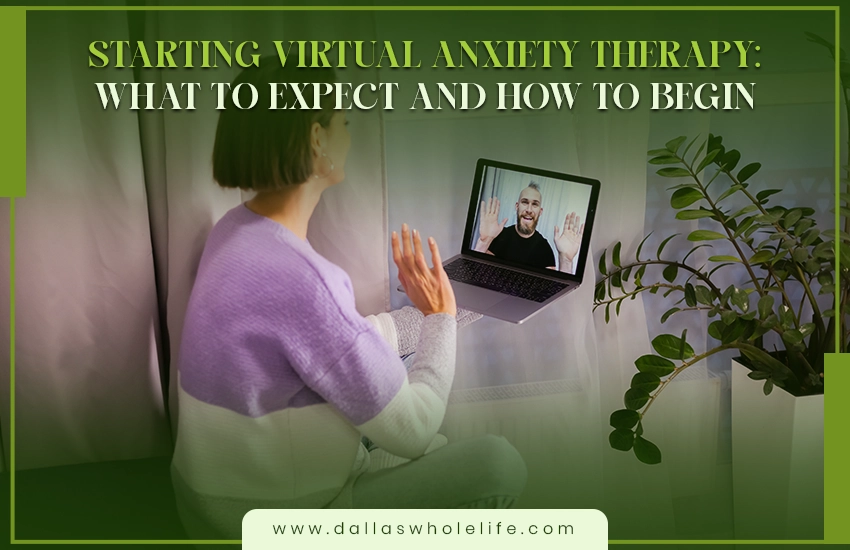
Starting online anxiety counseling is usually simpler than most people expect.
At Dallas Whole Life Counseling, the process may include requesting an appointment, completing intake paperwork, sharing insurance or payment information, and meeting with your therapist online at your scheduled time.
Your first session is usually about understanding you. It is not about forcing you into deep emotional work before you feel ready.
We may ask about:
- Your current anxiety symptoms
- Your mental health history
- Your medical history when relevant
- Your sleep, work, school, or relationship stress
- Your goals for therapy
- Your support system
- What has helped before
- What has made things harder
Together, we then build a treatment direction that fits your needs.
How to Know If Virtual Anxiety Therapy Is Right for You
Virtual anxiety therapy may be right for you if anxiety is affecting your life and you want support that is flexible, private, and easier to access.
It may be a good fit if:
- You overthink constantly
- You feel tense or restless
- You avoid things because of anxiety
- You have panic symptoms
- You struggle with social anxiety
- You feel overwhelmed by work or school
- You are a parent with limited free time
- You want therapy from home
- You live outside Dallas but still want care from a Texas-based provider
- You want practical tools you can use between sessions
It may not be the right fit if you do not have privacy, your internet connection is unreliable, you strongly prefer in-person support, or you need urgent crisis care.
A therapist can help you decide what level and format of care makes the most sense.
Do You Need Special Equipment for Online Therapy?
No special equipment is usually needed.
For most virtual sessions, you need:
- A smartphone, tablet, laptop, or computer
- A stable internet connection
- A private space
- A working camera and microphone if using video
- Headphones if you want extra privacy
It can also help to keep a notebook nearby if you want to write down coping tools, insights, or between-session exercises.
Can Virtual Therapy Help With Work Stress and Overthinking?
Yes, virtual therapy can help with work stress and overthinking.
Work anxiety often appears as constant pressure, fear of mistakes, difficulty switching off, perfectionism, people-pleasing, procrastination, or feeling responsible for everything.
Therapy can help you identify the thoughts and behaviors that keep stress active.
For example:
- “If I slow down, I’ll fall behind.”
- “If I make one mistake, people will lose respect for me.”
- “I have to say yes.”
- “I should be able to handle this.”
- “I need to check one more time.”
With support, you can practice healthier boundaries, realistic thinking, emotional regulation, and practical ways to respond to pressure.
What If You Miss a Session or Lose Internet Connection?
Life happens.
If you miss a session, need to reschedule, or experience internet issues, contact the office or your therapist as soon as possible. Every practice has its own scheduling policy, so it is important to review appointment and cancellation details before you begin.
If your connection drops during a session, your therapist may reconnect with you through the approved platform or discuss another appropriate option based on clinical and privacy needs.
To reduce the chance of tech issues, test your device, connection, camera, and microphone before your first appointment.
Is Virtual Anxiety Therapy Covered by Insurance?
Coverage depends on your insurance plan.
Dallas Whole Life Counseling accepts many major Texas insurance plans, and rates depend on your benefits, deductible, copay, coinsurance, and whether your therapist is in-network. For clients without insurance, sliding scale options may be available based on need and financial situation.
Virtual and in-person pricing may be the same, but your actual cost depends on your specific situation.
Before starting therapy, it is a good idea to check your benefits and confirm coverage for virtual mental health sessions.
Take the First Step Before Anxiety Makes the Next Decision
Anxiety has a way of convincing you to wait.
Wait until life calms down.
Wait until you feel less nervous.
Wait until you have more time.
Wait until you know exactly what to say.
Wait until things are worse.
But you do not have to wait for anxiety to give you permission.
Virtual anxiety therapy can help you understand what is happening, calm your nervous system, build practical coping skills, and take steady steps back towards the life you want.
At Dallas Whole Life Counseling, we offer online anxiety counseling for clients across Texas, with support for worry, panic attacks, social anxiety, stress, overthinking, and related concerns. We also offer evening and weekend appointments, and same-day or next-day appointment requests may be available depending on therapist availability and fit.
If anxiety is affecting your sleep, focus, relationships, work, school, or daily peace of mind, we are here to help.
FAQs
What is virtual anxiety therapy?
Virtual anxiety therapy is online counseling for anxiety. You meet with a licensed therapist through a secure video session, phone session, or approved online format instead of attending therapy in person.
How does online anxiety therapy work?
Online anxiety therapy works much like in-person therapy. You talk with your therapist about symptoms, triggers, thought patterns, coping skills, and goals, but the session happens remotely.
Is virtual therapy effective for anxiety?
For many people, yes. Research supports internet-based CBT and online therapy for a range of anxiety concerns. The right fit depends on your symptoms, comfort level, privacy, and treatment needs.
What types of anxiety can be treated online?
Online therapy can support generalized anxiety, panic attacks, social anxiety, health anxiety, work stress, overthinking, stress-related anxiety, and anxiety connected to other concerns.
What happens in a virtual anxiety therapy session?
A session may include discussing symptoms, identifying triggers, practicing coping tools, working through thought patterns, learning grounding skills, and creating small action steps for daily life.
Is virtual anxiety therapy confidential?
Virtual therapy should be conducted through secure systems and handled with the same professional care as in-person therapy. You will also need a private space on your end.
Do I need special equipment for online therapy?
Usually, you only need a smartphone, tablet, laptop, or computer with internet access, plus a quiet private space.
Can virtual therapy help with panic attacks?
Yes. Therapy can help you understand the panic cycle, practice breathing and grounding skills, reduce fear of panic symptoms, and create a plan for high-anxiety moments.
Is online therapy good for social anxiety?
Online therapy can be helpful for social anxiety because it lets you begin support from a familiar space while gradually building confidence and communication skills.
How do I know if virtual anxiety therapy is right for me?
It may be right for you if anxiety affects your sleep, focus, relationships, work, school, or daily choices, and you want flexible access to professional support.
How often should I attend virtual therapy sessions?
Many people begin with weekly sessions, but the right frequency depends on your symptoms, goals, therapist recommendation, and schedule.
Can I get coping tools in virtual therapy?
Yes. Your therapist may provide breathing exercises, grounding techniques, thought records, mindfulness tools, exposure steps, sleep strategies, or other practical exercises.
Is virtual anxiety therapy covered by insurance?
Coverage depends on your insurance plan, benefits, provider network, and session type. Dallas Whole Life Counseling accepts many major Texas insurance plans and offers other payment options.
What if I feel nervous talking on video?
That is very common. You can tell your therapist you feel nervous. You do not need to know exactly what to say before the session starts.
When should I seek professional help for anxiety?
You may want support if anxiety affects your sleep, work, relationships, school, parenting, decisions, physical comfort, or ability to enjoy daily life.
Can virtual therapy replace in-person therapy?
For many people, virtual therapy can be a strong alternative to in-person therapy. For others, in-person care may feel more appropriate. The best option depends on your needs and comfort level.

