

Acceptance and Commitment Therapy, also called ACT, is a mindfulness-based form of psychotherapy that helps you stop fighting difficult thoughts and feelings, accept what is happening inside you, and take action based on your personal values. ACT is often used for anxiety, depression, stress, burnout, trauma, grief, overthinking, emotional avoidance, and major life transitions. Instead of trying to erase every painful thought, ACT helps you build psychological flexibility, so you can respond to life with more choice, clarity, and steadiness.
Have you ever tried really hard not to think about something, only to think about it even more?
Maybe you tell yourself:
“Stop worrying.”
“Don’t feel sad.”
“Just calm down.”
“I shouldn’t be thinking this.”
“I need to get rid of this feeling before I can move forward.”
That sounds logical at first. If a thought or feeling hurts, of course you want it to stop.
But sometimes, the harder you try to control your inner world, the louder it gets. Worry becomes a loop. Sadness turns into self-criticism. Anxiety makes you avoid more things. Stress starts shaping your choices.
This is where Acceptance and Commitment Therapy can help.
ACT does not teach you to pretend everything is fine. It does not ask you to like painful emotions. And it does not mean giving up.
Instead, ACT helps you build a different relationship with your thoughts and feelings, so they do not have to run your life.

What Is Acceptance and Commitment Therapy?
Acceptance and Commitment Therapy is a modern form of behavioral therapy that combines mindfulness, acceptance, values, and committed action.
In simple terms, ACT helps you do two important things:
First, it helps you make room for difficult thoughts and emotions instead of constantly fighting them.
Second, it helps you take meaningful action, even when those thoughts and emotions are still present.
At Dallas Whole Life Counseling, we may use ACT as part of therapy for people dealing with anxiety, depression, trauma, grief, stress, burnout, relationship strain, life transitions, and emotional pain.
What Does “Acceptance” Mean in ACT?
This is one of the most misunderstood parts of ACT.
Acceptance does not mean you approve of what happened.
It does not mean you stop caring.
It does not mean you let people mistreat you.
It does not mean you give up on change.
In ACT, acceptance means making space for your internal experience instead of using all your energy to fight it.
That internal experience might include:
- Anxiety
- Sadness
- Anger
- Shame
- Grief
- Regret
- Fear
- Uncertainty
- Painful memories
- Unwanted thoughts
- Physical tension
Acceptance sounds like:
“I do not like this feeling, but I can allow it to be here without letting it control everything I do.”
That is very different from saying:
“I am fine with this.”
You are not trying to force yourself to be okay. You are learning how to stop wrestling with your mind so you can put your energy into what actually matters.
What Is the Main Goal of ACT?
The main goal of ACT is psychological flexibility.
That sounds clinical, but the idea is simple.
Psychological flexibility means you can notice what is happening inside you, stay connected to the present moment, and choose your next step based on your values rather than fear, avoidance, or automatic reactions.
For example, psychological flexibility might help you:
- Have a hard conversation instead of avoiding it
- Attend an event even though anxiety shows up
- Care for yourself during grief without shutting down
- Take one useful step during depression
- Set a boundary even when guilt appears
- Stop believing every harsh thought your mind produces
- Make choices based on what matters, not just what feels safest
ACT does not promise a life without pain. No therapy can honestly promise that.
But it can help you become less trapped by pain.
Why Trying to Control Your Thoughts Can Make Things Harder
Most of us try to control our thoughts because we want relief.
The problem is that the mind does not always respond well to force.
If you tell yourself not to think about something, your brain often checks whether the thought is still there. That checking keeps the thought active.
If you tell yourself anxiety is unacceptable, you may become anxious about being anxious.
If you judge sadness as weakness, you may feel sad and ashamed.
If you avoid every situation that brings discomfort, your world can slowly become smaller.
ACT helps you step out of this battle. Instead of asking, “How do I make this thought disappear?” ACT asks, “Can I notice this thought and still choose what matters?”
That shift can be powerful.
Who Can Benefit From ACT Therapy?
ACT can be helpful for many people, especially when your inner life feels exhausting or your emotions are starting to limit your outer life.
You may benefit from ACT therapy if you struggle with:
- Anxiety
- Depression
- Chronic stress
- Burnout
- Overthinking
- Worry loops
- Perfectionism
- Emotional avoidance
- Grief and loss
- Trauma-related distress
- OCD-related tendencies
- Low self-esteem
- Work stress
- Relationship stress
- Life transitions
- Feeling stuck or disconnected
You do not need to have the perfect words for what is wrong. Many people start therapy by saying, “I just know I do not feel like myself.”
That is enough.
You Know Something Feels Off, But You Do Not Know What Therapy to Choose
Choosing a type of therapy can feel confusing.
You may have heard of CBT, ACT, psychodynamic therapy, mindfulness, trauma therapy, family counseling, or individual counseling. It can be hard to know what fits when you are already feeling overwhelmed.
ACT may be a good fit if your main struggle is not only what you think but also how much power your thoughts and feelings seem to have over your life.
For example:
- You know the worry is not always logical, but it still controls your choices.
- You know you want to move forward, but fear keeps pulling you back.
- You know you are hard on yourself, but you cannot seem to stop.
- You know avoidance is making life smaller, but facing things feels too hard.
- You know what matters to you, but stress or sadness keeps getting in the way.
ACT meets you there.
How Does ACT Therapy Work?
ACT usually works through conversation, reflection, mindfulness exercises, practical tools, and action planning.
In therapy, we may help you look at questions like:
- What thoughts keep showing up?
- What emotions do you keep trying to avoid?
- What do you do when those feelings appear?
- Is that helping you long-term, or only giving short-term relief?
- What kind of person do you want to be in this part of your life?
- What values matter most to you right now?
- What small action could move you towards those values?
ACT is practical, but it is also deeply personal.
It is not just about coping better. It is about building a life that feels more connected to who you are and what you care about.
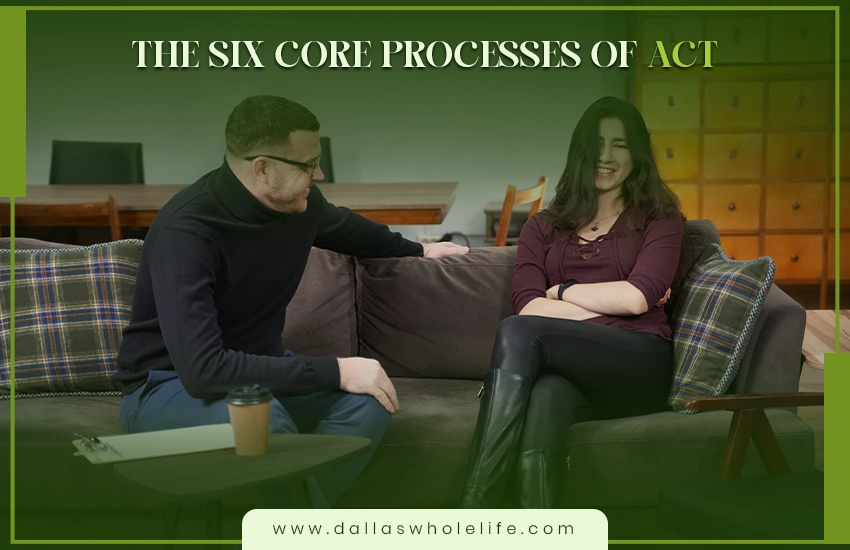
The Six Core Processes of ACT
ACT is often explained through six core processes. These are not separate steps you must complete in perfect order. They work together to help build psychological flexibility.
1. Acceptance
Acceptance means allowing difficult thoughts and feelings to exist without constantly pushing them away, denying them, or fighting them.
This does not mean you like the feeling. It means you stop giving the feeling complete control.
2. Cognitive Defusion
Cognitive defusion helps you step back from your thoughts.
Instead of treating every thought as a fact, you learn to notice it as a thought.
For example, instead of saying:
“I am a failure.”
You might learn to notice:
“I am having the thought that I am a failure.”
That small change can create space. The thought may still be there, but it may not feel as powerful.
3. Present Moment Awareness
This is the mindfulness part of ACT.
It helps you notice what is happening right now instead of getting pulled into the past, the future, or a mental argument that never seems to end.
This may involve noticing your breath, body, surroundings, emotions, or thoughts with more gentleness and less judgement.
4. Self-as-Context
This process helps you see that you are more than your thoughts, feelings, memories, roles, or labels.
You can have anxious thoughts without having anxiety.
You can feel sadness without being broken.
You can carry painful memories without being defined only by what happened.
This can be especially helpful for people who feel stuck in shame, trauma, grief, or self-criticism.
5. Values Clarification
Values are the qualities and directions that matter to you.
They might include honesty, courage, family, connection, faith, growth, creativity, compassion, responsibility, freedom, health, or service.
ACT helps you clarify what matters, not what you think should matter, not what others expect from you, but what genuinely matters to you.
6. Committed Action
Committed action means taking practical steps that line up with your values.
These steps can be small.
Sending the message.
Taking the walk.
Setting the boundary.
Showing up to therapy.
Applying for the role.
Asking for help.
Resting instead of pushing through.
Doing one thing that supports the life you want.
ACT is not just about insight. It is about movement.

Is ACT Based on Mindfulness?
Yes. Mindfulness is a central part of ACT.
But ACT mindfulness is not about clearing your mind or becoming perfectly calm.
Many people think mindfulness means sitting quietly with no thoughts. Then, when their mind keeps talking, they think they are doing it wrong.
That is not the goal.
In ACT, mindfulness means noticing your experience with more openness. You might notice:
“My chest feels tight.”
“My mind is predicting the worst.”
“I am feeling shame.”
“I want to avoid this.”
“I am remembering something painful.”
The aim is not to delete the experience. The aim is to notice it clearly enough that you can choose your next step.
Can ACT Help With Anxiety and Stress?
ACT can be helpful for anxiety and stress because both often involve a strong urge to control, predict, avoid, or escape discomfort.
Anxiety says:
“What if something goes wrong?”
“What if I cannot handle it?”
“What if they judge me?”
“What if this feeling never stops?”
Stress says:
“You must keep pushing.”
“You cannot slow down.”
“You are behind.”
“You have to handle everything.”
ACT helps you notice these thoughts without automatically obeying them.
It can support people dealing with:
- General worry
- Racing thoughts
- Social anxiety
- Panic symptoms
- Work stress
- Burnout
- Health anxiety
- Performance pressure
- Fear of uncertainty
If anxiety is interfering with your daily life, our Online Anxiety Therapy may also be helpful.
Can ACT Help With Depression?
ACT can also support people dealing with depression, especially when depression has led to withdrawal, low motivation, hopeless thoughts, or disconnection from meaningful activities.
When you are depressed, your mind may say:
“There is no point.”
“I am too tired.”
“I will fail anyway.”
“Nothing will change.”
“I am a burden.”
ACT does not ask you to argue with every painful thought. Instead, it helps you notice those thoughts and gently reconnect with actions that matter, even if your mood has not fully lifted yet.
That might mean reconnecting with a person, routine, value, interest, or responsibility in a realistic way.
Not all at once. Not perfectly. Just one step at a time.
Can ACT Help With Trauma, Grief, or Life Transitions?
ACT may be helpful when trauma, grief, or major change has left you feeling stuck between wanting to move forward and feeling unable to do so.
With trauma, ACT can help you relate differently to painful memories, triggers, fear, and avoidance while still respecting your pace and safety.
With grief, ACT can help you make space for loss while slowly reconnecting with life, love, routine, and meaning.
With life transitions, ACT can help when your identity, relationships, work, health, or future plans have changed in ways you did not expect.
It is important to say this clearly: ACT does not rush healing. It does not tell you to “just accept it” and move on.
It helps you carry painful experiences with more support, more awareness, and more room to choose what comes next.
ACT vs CBT: What Is the Difference?
ACT and Cognitive-Behavioral Therapy, or CBT, are related, but they are not the same.
CBT often helps you identify, challenge, and change unhelpful thought patterns.
ACT focuses more on changing your relationship with your thoughts.
Here is a simple way to understand the difference.
CBT may ask:
“Is this thought accurate?”
“What evidence supports or challenges this thought?”
“What would be a more balanced thought?”
ACT may ask:
“Is this thought helpful?”
“What happens when you get hooked by this thought?”
“Can this thought be present while you still act on your values?”
Both approaches can be useful. One is not automatically better than the other.
At Dallas Whole Life Counseling, our therapists use Cognitive-Behavioral Therapy, ACT, mindfulness-based tools, psychodynamic therapy, or other approaches depending on your needs.
ACT Therapy vs Other Approaches: Which One Actually Works for You?
The most helpful therapy is the one that fits your needs, your goals, your personality, and the type of struggle you are facing.
ACT may be a strong fit if you:
- Feel trapped in overthinking
- Try hard to suppress emotions
- Avoid situations that matter to you
- Struggle with uncertainty
- Feel controlled by fear or shame
- Want practical tools
- Want therapy that connects to values and real-life choices
- Are tired of arguing with your mind
- Want to build a more meaningful life, not just reduce symptoms
CBT may be a strong fit if you want to work directly with thought patterns, beliefs, and behaviours.
Psychodynamic therapy may be helpful if you want to explore deeper emotional patterns, past experiences, relationships, and recurring themes.
Family or couples counseling may be a fit when the issue involves the relationship system, not only one person.
You do not have to choose alone. Part of our role is helping you find an approach that makes sense for you.
How ACT Helps With Overthinking
Overthinking can feel like problem-solving, but often it becomes a loop.
You replay conversations.
You imagine worst-case scenarios.
You check and recheck decisions.
You try to find certainty before you act.
You analyze your feelings until you feel even more confused.
ACT helps you notice when your mind is trying to protect you, but doing it in a way that keeps you stuck.
A therapist may help you practice defusion tools such as:
- Naming the thought
- Thanking the mind for trying to help
- Noticing thoughts as mental events
- Returning attention to the present moment
- Choosing one value-based action instead of another round of rumination
The goal is not to stop thinking forever. The goal is to stop letting overthinking make every decision for you.
How ACT Helps You Cope With Uncertainty
Uncertainty is one of the hardest things for the human mind to tolerate.
We want answers. We want guarantees. We want to know that everything will be okay before we take a step.
But life does not always give us that.
ACT helps you build tolerance for uncertainty by asking:
“What can I control here?”
“What is outside my control?”
“What kind of person do I want to be in this uncertain moment?”
“What action lines up with my values, even without a guarantee?”
This can be especially helpful for anxiety, health fears, relationship stress, parenting worries, work pressure, grief, and major life decisions.
How ACT Helps You Live According to Your Values
Values are a major part of ACT because they give therapy direction.
Without values, therapy can become only about reducing discomfort.
But life is not just about feeling less bad. It is also about moving towards what matters.
Your values might show up in questions like:
- What kind of parent, partner, friend, or family member do I want to be?
- What matters to me when life is hard?
- What do I want my choices to stand for?
- What have I been avoiding that actually matters to me?
- What would I do if anxiety did not get the final vote?
- What kind of life do I want to build from here?
Values are not goals you tick off once and finish. They are directions you keep returning to.
A goal might be “apply for a new job”.
A value might be “growth” or “courage”.
A goal might be “have dinner with my family twice this week”.
A value might be “connection”.
ACT helps connect daily actions to those deeper values.
What Happens in an ACT Session?
An ACT session is a real conversation, not a lecture.
Depending on your needs, your therapist may help you:
- Talk through what has been feeling difficult
- Notice the thoughts and emotions that keep showing up
- Understand patterns of avoidance
- Practice mindfulness or grounding
- Learn defusion exercises
- Explore your values
- Create small, realistic action steps
- Reflect on what worked and what felt hard
- Build skills you can use between sessions
You will not be forced to talk about anything before you are ready. Therapy should feel supportive, respectful, and paced around your needs.
Is ACT Short-Term or Long-Term Therapy?
ACT can be short-term, medium-term, or part of longer-term therapy.
For some people, ACT is focused and practical. They may work on anxiety, stress, or a specific life pattern over a shorter period.
For others, ACT becomes part of deeper therapy involving trauma, grief, depression, relationships, identity, or long-standing emotional patterns.
The length of therapy depends on your goals, symptoms, history, support system, and how much you want to work on.
There is no single timeline that fits everyone.
ACT for Teens and Young Adults
ACT can also be helpful for teens and young adults because it gives them practical tools for emotions, identity, pressure, uncertainty, and self-criticism.
Teenagers and young adults may struggle with:
- School stress
- Social anxiety
- Family conflict
- Identity questions
- Friendship issues
- Low mood
- Perfectionism
- Body image concerns
- Future pressure
- Emotional overwhelm
- Avoidance
- Motivation
ACT can help them notice hard thoughts without being defined by them, understand what matters to them, and take steps that support growth.
At Dallas Whole Life Counseling, we offer Child & Teens Counseling for children, adolescents, and teens ages 6 and up.
Can ACT Help With Work Stress and Burnout?
Yes, ACT can be very useful when work stress has taken over your mind, body, and sense of self.
Burnout often creates thoughts like:
“I cannot stop.”
“I have to keep everyone happy.”
“If I slow down, everything will fall apart.”
“I should be able to handle this.”
“I am failing.”
ACT helps you look at the cost of living from pressure, fear, or perfectionism.
It may help you reconnect with values such as health, family, honesty, balance, purpose, service, growth, or stability.
Then, therapy can help you take realistic steps that support those values.
That might include boundaries, rest, communication, problem-solving, self-compassion, or changing how you relate to pressure.
Is Online ACT Therapy Available?
Yes. At Dallas Whole Life Counseling, we offer online therapy through secure Zoom sessions for clients across Texas.
Online therapy can be especially helpful if you:
- Have a busy schedule
- Prefer therapy from home
- Live outside Dallas or Fort Worth
- Want to avoid travel time
- Need evening or weekend appointment options
- Feel more comfortable opening up in a familiar space
We support individuals, kids, teens, couples, and families through online and in-person options.
How to Know If ACT Is Right for You
ACT may be right for you if you are tired of fighting your own mind.
You may want to consider ACT if:
- You overthink constantly
- You avoid things that matter
- You feel controlled by anxiety, sadness, guilt, or shame
- You want practical tools
- You feel stuck in the same emotional patterns
- You want to understand your values
- You want therapy that helps you take action
- You want to stop waiting until you feel “ready” to live your life
- You want to respond differently to stress, uncertainty, or painful thoughts
You do not have to know for certain before starting. Your therapist can help you decide whether ACT, CBT, mindfulness, psychodynamic therapy, or another approach is the right fit.
Start Where You Are, Not Where You Think You Should Be
You do not need to be calm before you start therapy.
You do not need to have your thoughts organised.
You do not need to know exactly what is wrong.
You do not need to have the perfect goal.
You do not need to be ready for massive change.
You can start with exactly what is true today.
Maybe you are anxious.
Maybe you are tired.
Maybe you are grieving.
Maybe you are overwhelmed.
Maybe you are stuck in the same loop again and again.
ACT can help you stop using all your energy to fight your thoughts and start using that energy to move towards the life you want to build.
At Dallas Whole Life Counseling, we offer Acceptance and Commitment Therapy, online therapy, and other evidence-based approaches for anxiety, depression, trauma, grief, stress, and life transitions.
If you feel stuck in overthinking, emotional pain, or constant inner conflict, we are here to help you take the next step.
FAQs
What is Acceptance and Commitment Therapy?
Acceptance and Commitment Therapy, or ACT, is a mindfulness-based therapy that helps you accept difficult thoughts and feelings while taking action based on your values.
How does ACT therapy work?
ACT works by helping you notice thoughts, make room for emotions, practice mindfulness, clarify your values, and take practical steps that support the life you want.
What is the main goal of ACT?
The main goal of ACT is psychological flexibility. This means being able to stay present, notice your inner experience, and choose actions based on your values instead of reacting automatically.
What does acceptance mean in ACT?
Acceptance means allowing thoughts and feelings to be present without constantly fighting them. It does not mean giving up or approving of painful situations.
What are the six core processes of ACT?
The six core ACT processes are acceptance, cognitive defusion, present moment awareness, self-as-context, values clarification, and committed action.
Is ACT based on mindfulness?
Yes. ACT uses mindfulness to help you notice thoughts, feelings, body sensations, and urges with more awareness and less judgement.
Can ACT help with anxiety?
ACT can help many people with anxiety by reducing avoidance, building tolerance for uncertainty, and helping you take value-based action even when worry is present.
Can ACT help with depression?
ACT may help with depression by supporting small, meaningful actions and helping you relate differently to painful thoughts, low motivation, and hopelessness.
Can ACT help with trauma?
ACT can be used as part of trauma-informed therapy. It may help people relate differently to painful memories, triggers, avoidance, and emotional distress.
Can ACT help with grief?
ACT can support grief by helping you make space for painful emotions while slowly reconnecting with meaning, relationships, and daily life.
What is the difference between ACT and CBT?
CBT often focuses on identifying and changing unhelpful thoughts. ACT focuses more on changing your relationship with thoughts, so they have less control over your actions.
Is ACT short-term or long-term therapy?
ACT can be either short-term or long-term depending on your needs, goals, symptoms, and the issues you want to work through.
What happens in an ACT session?
An ACT session may include talking through current struggles, noticing thought patterns, practicing mindfulness, exploring values, and planning small actions between sessions.
Is ACT good for overthinking?
ACT can be helpful for overthinking because it teaches you how to notice thoughts without getting pulled into every mental loop.
How do I know if ACT is right for me?
ACT may be a good fit if you struggle with overthinking, avoidance, anxiety, emotional pain, uncertainty, or feeling stuck. A therapist can help you decide whether ACT fits your goals.
Does Dallas Whole Life Counseling offer online ACT therapy?
Yes. We offer online therapy through secure Zoom sessions for clients across Texas, and ACT may be used as part of your treatment depending on your needs and therapist fit.
