

Virtual couples therapy or online relationship counseling is the modern solution for partners who want to strengthen their bond without the stress of a commute. It’s professional guidance delivered straight to your couch, ensuring that “working on us” fits into your actual life.

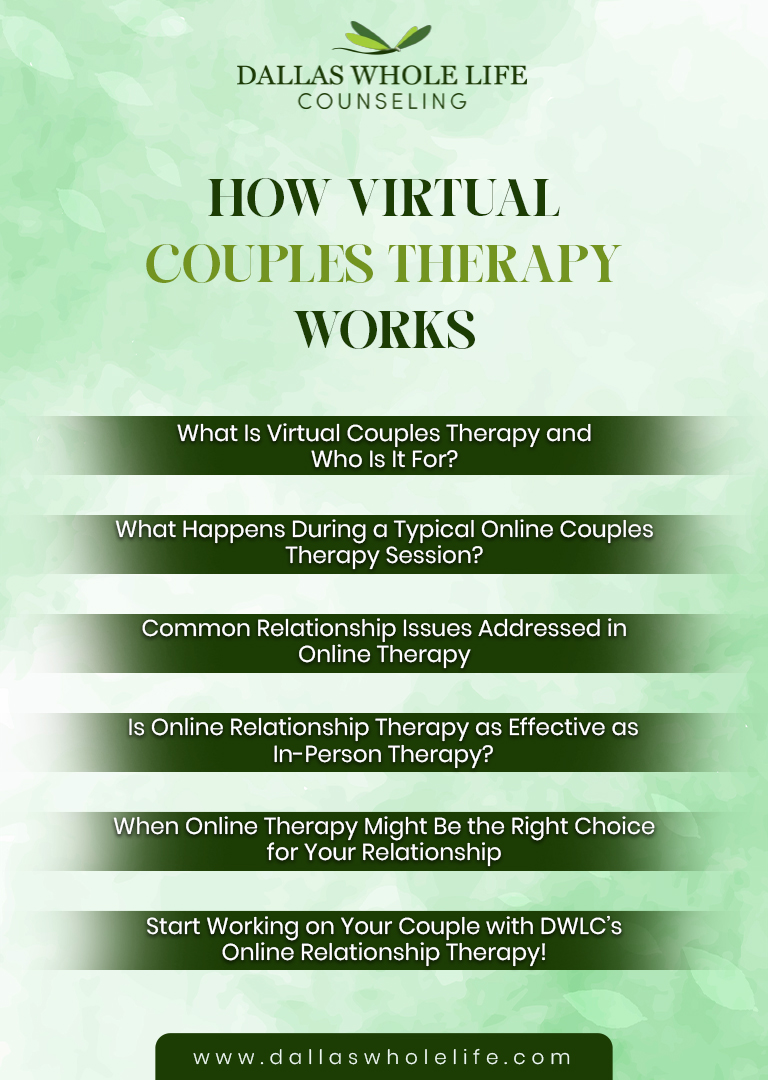
What Is Virtual Couples Therapy and Who Is It For?
At its core, virtual therapy is a secure video connection between you, your partner, and a licensed professional. It’s designed for anyone in a committed relationship, whether you’re married, in a long-term partnership, going through a “rough patch,” or even living in different zip codes.
Virtual couples therapy can benefit:
- Couples balancing kids and careers.
- Partners maintaining a relationship from different locations.
- Those who feel more vulnerable (and thus more honest) in their own living room than in a clinical office.
What Happens During a Typical Online Couples Therapy Session?
A typical session isn’t just “venting” into a webcam. Online relationship therapy is a structured process that helps partners better understand one another and build healthier relationship patterns over time.
- Step 1. Initial sessions focus on understanding relationship history and current challenges
- Step 2. Each partner is given space to express their perspective
- Step 3. The therapist identifies communication patterns and emotional triggers
- Step 4. Sessions include guided discussions, communication tools, and practical exercises
- Step 5. Progress is built over time through consistent sessions
Common Relationship Issues Addressed in Online Therapy
You don’t need a “crisis” to start therapy. But it is highly effective for:
- Communication breakdown and recurring arguments
- Emotional distance or lack of intimacy
- Trust issues, including infidelity
- Parenting conflicts and life transitions
- Conflict resolution and boundary-setting challenges
Is Online Relationship Therapy as Effective as In-Person Therapy?
The short answer: Yes.
Research suggests that online therapy is just as effective as in-person sessions. In fact, some couples find it more effective because the “home-court advantage” allows them to be more relaxed and open. The success of therapy isn’t determined by the four walls of an office. It’s determined by the consistency of the sessions and the willingness of both partners to engage.
When Online Therapy Might Be the Right Choice for Your Relationship
Every relationship has its own rhythm and set of issues. Online sessions offer the flexibility needed to address these head-on, making virtual therapy an ideal choice for:
- Busy schedules or long-distance relationships
- Limited access to local therapists
- Preference for privacy and comfort at home
- Early-stage conflicts where intervention can prevent escalation
- Couples wanting to proactively strengthen their relationship

Start Working on Your Couple with DWLC’s Online Relationship Therapy!
Every relationship experiences challenges. But you do not have to navigate them alone. DWLC’s Online Relationship Therapy provides the expert guidance you need with the flexibility you deserve. Invest in your partnership from the comfort of your own home.
Our therapists work with couples to create healthier relationship patterns and help partners move toward greater understanding and connection.
Contact us today to schedule your online relationship therapy session today.
Frequently Asked Questions
How long do virtual therapy sessions last?
They typically last between 45 and 60 minutes, commonly known as a clinical hour. While 50 minutes is standard for individual therapy, sessions range from 30 to 60 minutes depending on the provider or patient needs.
What is a red flag in therapy?
Some warning signs are broken boundaries (oversharing, dual relationships), feeling judged or dismissed, lack of tailored treatment, and unethical behavior.
How long do most couples stay in couples therapy?
Most couples attend therapy for 12 to 25 sessions. They typically span 3 to 10 months. While some couples see significant improvement in as few as 8 sessions, others with deeper, long-standing issues may continue counseling for a year or longer.
What not to say in couples therapy?
In couples therapy, avoid using absolutes like you always/never, defensive language (you’re overreacting), or ultimatums (I’m leaving if…). It shuts down communication. Do not play the Blame Game. Focus on sharing your own feelings and taking responsibility, as therapy is for connection, not winning arguments
