

The argument starts over a receipt, a subscription neither of you remember signing up for, or a number on a shared statement that does not match what you expected. Ten minutes later, you are not really talking about the charge anymore. You are talking about whether you can trust each other, whether one of you is careless and the other controlling, or whether you are actually on the same team. Money has a way of doing that. It rarely stays about the number for long.
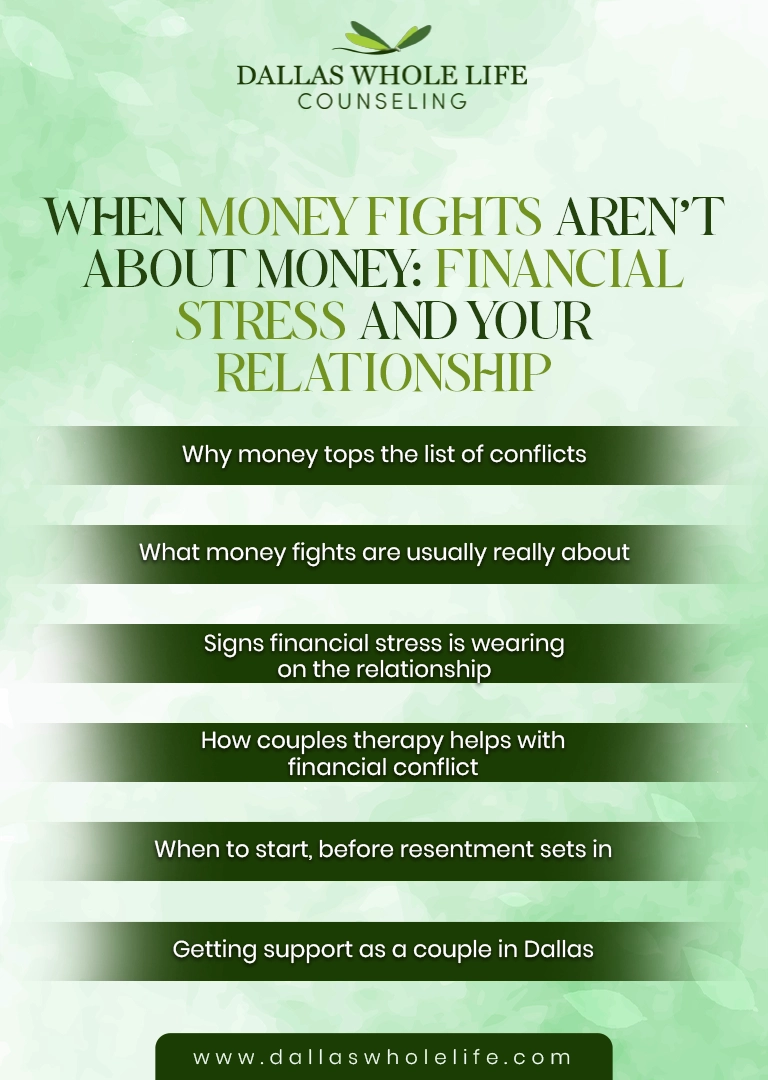
Why Money is A Common Source of Relationship Conflict

Money is consistently one of the most common sources of tension couples report, and the data backs up what most relationships already know from experience. Fidelity Investments’ 2024 Couples & Money Study found that 45% of partners admit they argue about money at least occasionally, and more than one in four couples name money as their single greatest relationship challenge. A separate AICPA survey found that seven in ten married or cohabiting Americans had a disagreement about finances in the past year, and about one in four said financial decisions are a source of tension at least once a month.
What stands out in that research is not just how often couples argue about money, but how much weight those arguments carry. Financial disagreements tend to get remembered longer and cut deeper than a fight about whose turn it is to do the dishes, because money rarely stays contained to the topic at hand.
What Money Fights Are Usually Really About
Underneath a fight about spending is often a fight about something else entirely: security, values, fairness, or control. Someone who grew up with financial instability may feel a flare of panic at a large purchase that has nothing to do with whether the household can actually afford it. Someone who values experiences over savings may feel judged by a partner who values a full emergency fund, and vice versa, even when both are being financially responsible in their own way.

Therapists sometimes call these patterns money scripts, meaning the beliefs about money we absorb early in life, often without ever discussing them directly. If one partner grew up in a household where money was never talked about, and the other grew up watching parents argue over every bill, they can walk into the same conversation with completely different instincts about what a receipt means. Neither script is wrong. They are just different, and without naming them, couples tend to argue about the surface issue instead of the belief underneath it.
Fairness and control show up often too. Questions like who earns more, who decides how it gets spent, and who feels like they have to ask permission can carry a lot of emotional weight, especially when income is unequal or one partner manages the finances alone. None of that is really about the dollar amount. It is about whether both people feel like equal partners.
Values are another layer. One partner might see saving aggressively as responsible, while the other experiences it as deprivation. One might see a spontaneous purchase as generosity or joy, while the other reads it as recklessness. Neither reading is inherently correct, but when values collide without either person naming them out loud, the fight tends to land on the surface transaction instead of the belief driving it, which makes the same disagreement resurface again and again without ever really being resolved.
Signs Financial Stress is Wearing on The Relationship
Not every money disagreement is a red flag. These are patterns worth paying attention to when they start to repeat.

Avoidance
Some couples handle financial stress by simply not talking about it. Bills go unopened, budgets never get discussed, and both partners quietly hope the other one is handling it. Avoidance can look peaceful on the surface, but it usually means the underlying disagreement never actually gets resolved, it just goes underground.
Secrecy, Sometimes Called Financial Infidelity
This includes hidden purchases, undisclosed debt, or secret accounts a partner does not know about. It does not have to involve a large sum of money to damage trust. The secrecy itself, more than the amount, is usually what causes the deeper rupture.
The Same Argument, on A Loop
If you and your partner keep having a version of the same money fight without ever actually resolving it, that repetition is itself a sign. It usually means the conversation keeps happening at the surface level, spending, saving, a specific purchase, without ever reaching what is actually driving it.
How couples therapy helps with financial conflict
A couples therapist is not there to referee who is right about the budget. The work is usually about slowing the conversation down enough to see what is actually being argued about, and building tools for talking about money without it turning into a fight about trust or worth.

That often includes concrete communication tools, ways to raise a financial concern without it landing as an accusation, and de-escalation strategies for when a money conversation starts to spiral. It also involves building shared meaning around money, helping both partners articulate what security, generosity, or freedom actually mean to them, so financial decisions can reflect shared values instead of two people pulling in opposite directions.
No therapist can promise a specific financial outcome or guarantee that money will stop being difficult. What tends to change is the pattern itself, so that a disagreement about a purchase does not have to become a referendum on the relationship every time it comes up. Couples often come in expecting to leave with a shared budget or a fixed set of financial rules. What they more often leave with is a better read on each other, enough to have the harder conversations without either person shutting down or escalating.
When To Start, Before Resentment Sets in

Couples often wait until financial stress has already done real damage before reaching out, after months or years of the same fight, after trust has already been dented by a secret purchase, or after one partner has quietly started keeping score. Earlier is almost always easier. A pattern that has only shown up a handful of times is much easier to shift than one that has calcified into resentment on both sides.
You do not need a crisis to justify starting. Wanting to understand each other’s money habits better, or wanting to stop the same argument from resurfacing every few months, is reason enough. Financial stress can also be one of several threads pulling a couple apart rather than the whole story on its own, sometimes showing up alongside a general sense of drifting apart or feeling more like roommates than partners, so it is worth naming everything that feels off, not just the money piece, when you reach out.
It helps to think of financial disagreement less like a problem to solve once and be done with, and more like an ongoing conversation that needs a working structure. Couples who build that structure early, even informally, tend to weather bigger financial stress later, a job loss, a move, a new baby, with far less collateral damage to the relationship itself.
Getting Support As A Couple In Dallas

Dallas Whole Life Counseling offers couples therapy in Dallas with licensed therapists experienced in relationship dynamics, including financial conflict. Sessions are available in person at the Dallas Galleria Tower One office or virtually anywhere in Texas, with evening and weekend appointments for couples juggling two schedules.
We are in-network with Aetna, Blue Cross Blue Shield of Texas, Cigna, Medicare, United Healthcare, UMR, and Optum. Not every therapist accepts every plan, so tell us your insurance, and we will match you with someone who does and check your benefits. Private pay is also available on a sliding scale, and a full breakdown of how coverage works, including for virtual sessions, covers the details if you want them before you book. Make an appointment online or call (972) 755-0996, and new clients are often seen within about three days.
Frequently Asked Questions
Are money fights really about money?
Often not entirely. Underneath a specific disagreement is frequently a deeper issue such as security, fairness, differing values, or control. The dollar amount can be real and still not be the whole story.
Can couples therapy help with financial conflict?
Yes. A therapist can help you understand what is really driving the disagreement, build communication tools for talking about money without it escalating, and work toward shared financial values rather than opposing positions.
What if only one of us wants to go?
Starting with individual therapy is a reasonable option if your partner is not ready for couples sessions yet. Some people also find that once they start working on the pattern individually, their partner becomes more open to joining later.
Do you take insurance?
We are in-network with Aetna, Blue Cross Blue Shield of Texas, Cigna, Medicare, United Healthcare, UMR, and Optum. Private pay is also available on a sliding scale.
Do you offer virtual couples sessions?
Yes. Couples can meet virtually from anywhere in Texas, or in person at the Dallas Galleria Tower One office, whichever fits your situation better.
