

Want to start therapy for your better mental health? A good decision. But once you’ve made that choice, a new question often arises:
“Should you meet with a therapist in person or online?”
In recent years, mental healthcare has moved from traditional office-bound sessions to a more flexible model that includes high-quality virtual options. That is why you need to understand the nuances/differences between these two formats. So, you can easily find the path that feels most comfortable and effective for you and your lifestyle.
In both of them, the medium of communication differs. Still, the core objective remains the same. That is providing a safe space for self-discovery and healing. These therapeutic processes help you navigate the challenges of your life. The difference comes down to personal preference and logistical needs. Also, the way you best connect with others.
Research has consistently shown that the efficacy of treatment is not diminished by a digital screen. According to the American Psychological Association, teletherapy is a highly effective alternative to in-person care. It offers similar outcomes for a wide range of mental health concerns. The key is not necessarily where you do the work. But the commitment you bring to the process and the strength of the bond you form with your provider.

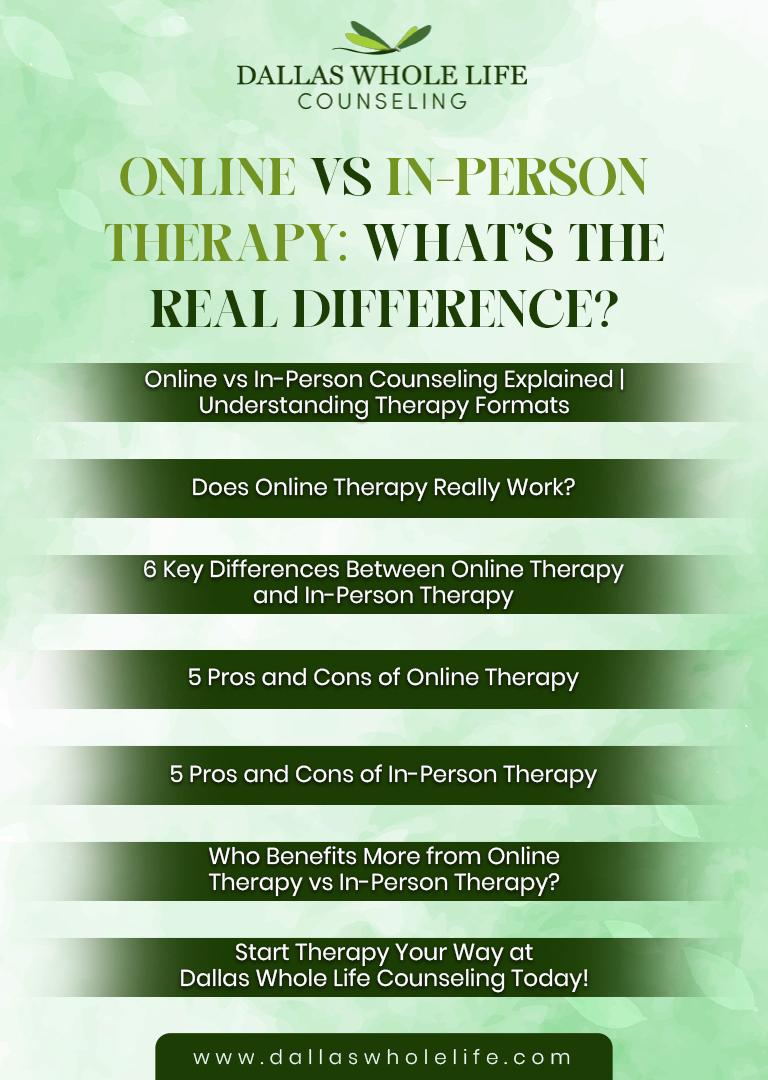
Online vs In-Person Counseling Explained | Understanding Therapy Formats
Both online and in-person therapy provide professional mental health support. But you need to recognize the primary difference. It lies in how sessions are delivered. Not the quality of care provided.
In an in-person setting, sessions take place in a traditional office environment. It offers a physical space away from the distractions of daily life. Online therapy (teletherapy) connects you with a licensed professional regardless of your physical location via video, phone, or secure platforms.
These setups differ. However, the therapeutic goals remain identical. Both formats aim to provide emotional support. They teach healthy coping skills. They facilitate meaningful behavior change. Whether you are meeting face-to-face or via a monitor, the effectiveness of the treatment depends more on consistency and the therapist relationship than format.
Does Online Therapy Really Work?
Research shows online therapy produces outcomes similar to in-person sessions. For common concerns such as anxiety, depression, and chronic stress. The virtual format removes major barriers to care. For example, transportation issues or scheduling conflicts. It actually leads to higher rates of engagement. Virtual counseling is easier to attend. So, patients are more likely to stay consistent. Consistency is one of the strongest predictors of its long-term success.
Many people feel more open and vulnerable when in a familiar, controlled environment. Like their own home. This sense of security in virtual space can accelerate the process of building a strong therapeutic relationship. Modern technology allows for clear, real-time communication. It captures facial expressions and tone of voice. Thus, ensuring the human connection at the heart of therapy remains vibrant and effective in a digital space.
6 Key Differences Between Online Therapy and In-Person Therapy
| Feature | Online Therapy | In-Person Therapy |
| Location | Anywhere with a private internet connection | A dedicated professional office |
| Commute | Zero travel time required | Requires travel to and from a clinic |
| Privacy | You control your physical surroundings | Guaranteed soundproof and private environment |
| Non-Verbal Cues | Focused primarily on facial and vocal cues | Full-body language and energy presence |
| Technical Needs | Requires reliable Wi-Fi and a device | No technology or internet required |
| Scheduling | Often more flexible for early/late hours | Subject to office hours and room availability |

5 Pros and Cons of Online Therapy
Benefits of virtual counseling:
- Eliminates travel time
- Provides access to specialists, regardless of location
- Cheaper than in-person sessions
- Allows scheduling in one’s home, increasing comfort levels
- Offers enhanced privacy and anonymity
Limitations of teletherapy:
- Dependent on internet reliability, causing session interruptions or failures
- Harder for therapists to read body language and for clients to feel empathy
- Inadequate for complex psychiatric needs or immediate interventions
- State regulations may prohibit out-of-state providers from practicing
- Difficulty finding a truly quiet, private environment

5 Pros and Cons of In-Person Therapy
Benefits of traditional therapy:
- Stronger sense of personal connection for some clients
- Full access to body language and nonverbal cues
- Structured, distraction-free environment
- No reliance on technology
- Ideal for more intensive or complex needs
Limitations of traditional therapy:
- Requires travel and time commitment
- Less flexible scheduling
- May feel intimidating for some individuals
- Limited accessibility for those in remote areas
- Potential scheduling conflicts with busy lifestyles

Who Benefits More from Online Therapy vs In-Person Therapy?
| Best For… | Online Therapy | In-Person Therapy |
| Busy Professionals | High Benefit (Saves time) | Moderate Benefit |
| Social Anxiety | High Benefit (Lower initial barrier) | High Benefit (Gradual exposure) |
| Severe Trauma/PTSD | Moderate Benefit | High Benefit (Enhanced safety cues) |
| Rural Residents | High Benefit (Increases options) | Low Benefit (High travel burden) |
| Children & Teens | Moderate Benefit (Tech-savvy) | High Benefit (Play/Activity therapy) |
The right format depends heavily on personal needs and preferences. For instance, a person with a demanding corporate job picks online therapy. Why? Because it is the only way they can remain consistent with their mental health goals. Conversely, someone seeking treatment for complex trauma might find that the physical presence of a therapist provides a unique sense of safety and grounding. That is difficult to replicate through a screen.

Start Therapy Your Way at Dallas Whole Life Counseling Today!
At Dallas Whole Life Counseling, we believe that therapy should fit your life. Not the other way around. We recognize that every individual’s journey is different. This is why we offer both in-person sessions at our welcoming offices and secure online therapy options for clients throughout Texas. Our priority is providing you with expert, compassionate care in the format that makes you feel most empowered to do your best work.
Choosing the right format is a personal decision. Our team is here to help you navigate that choice. If you value the ritual of a dedicated office space and the nuances of face-to-face interaction, our DFW-based offices are ready for you. If you need the flexibility of virtual care to balance your career and self-care, our teletherapy platform provides a seamless, professional experience from any private location.
Your mental health is an investment in your future happiness and stability. Whether you join us on the couch or through the screen, you will receive the same high standard of evidence-based care and personalized attention.
Contact Dallas Whole Life Counseling today to schedule your initial consultation. Take the first step toward a more balanced, fulfilling life, that too, on your terms.
Frequently Asked Questions
Which is better, online therapy or in-person therapy?
Neither is universally better. Both are effective. The right choice depends on your comfort level and personal preferences.
Is online therapy effective?
Yes. Research shows online therapy is as effective for many mental health concerns, especially when sessions are consistent.
Who should not use online therapy?
Individuals experiencing severe mental health crises or those who need intensive, in-person support.
Is in-person therapy more expensive than online therapy?
Prices can vary. But in-person therapy sometimes cost higher due to overhead expenses like office space.
How do I choose between online and in-person therapy?
Consider factors like your schedule, comfort with technology, need for flexibility, and whether you prefer face-to-face interaction.
