

Attention-Deficit/Hyperactivity Disorder (ADHD) is often discussed in the context of childhood. It isn’t just something that affects kids in school. For many adults, it is a daily reality that shapes their professional and personal lives. Far from being a simple matter of “high energy,” adult ADHD involves a complex set of executive function challenges. When left unmanaged, these symptoms create a disconnect between an individual’s true potential and their daily output.
The impact of ADHD is not confined to a single area of life. It affects everything from the way you interact with colleagues to the intimacy you share with a partner. According to CHADD (Children and Adults with Attention-Deficit/Hyperactivity Disorder), adult ADHD leads to significant difficulties in maintaining stable employment and healthy long-term relationships.
These struggles are rooted in neurobiology, not a lack of willpower or character. When you understand that, only then can you take steps toward making meaningful changes. If you suspect your struggles might be linked to these patterns, try using our adult ADHD self-evaluation tool to gain more clarity. At Dallas Whole Life, we help people move from feeling overwhelmed to feeling confident again.

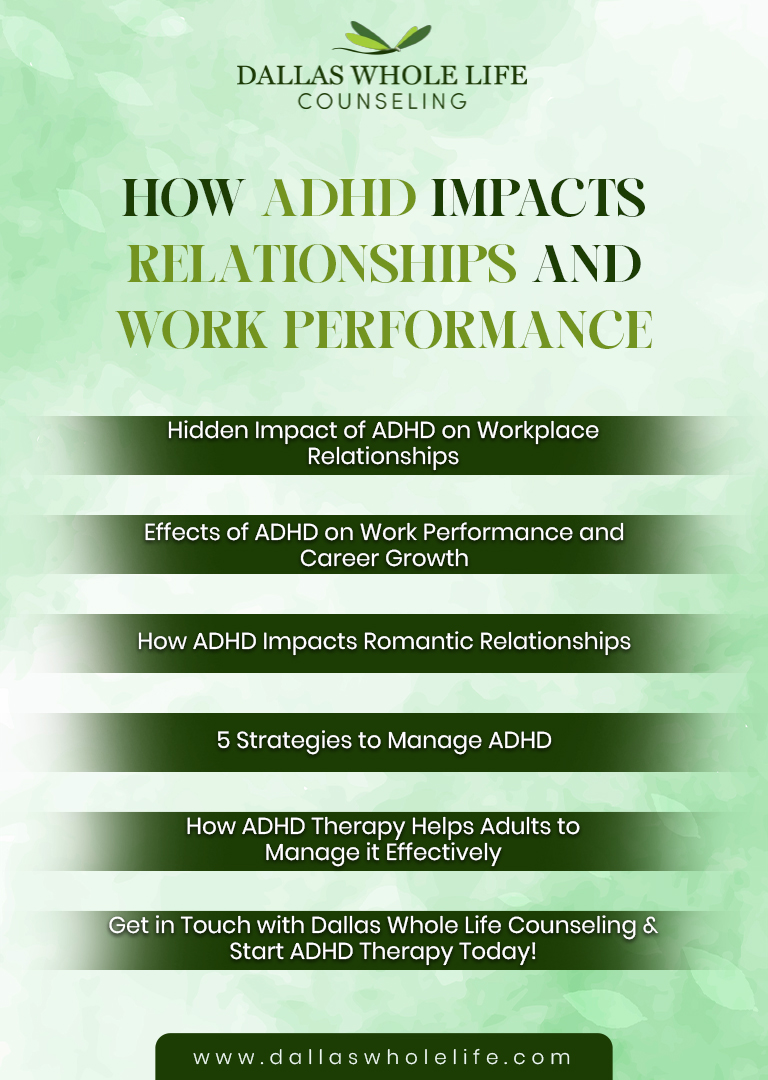
Hidden Impact of ADHD on Workplace Relationships
At work, we rely on communication to get things done. If you have ADHD, you might accidentally miss social cues or forget what a coworker asked you to do. This isn’t because you don’t care. It’s because your brain is busy processing a million other things at once. Unfortunately, coworkers might see this as a lack of interest or respect, which creates a gap between you and your team.
- Miscommunication due to distraction or inattention
- Interrupting conversations or speaking impulsively
- Forgetting meetings, details, or commitments
- Perceived unreliability by coworkers or managers
- Difficulty handling feedback or criticism

Effects of ADHD on Work Performance and Career Growth
Beyond the social aspect, ADHD directly affects productivity. Some days you are incredibly focused and get a week’s worth of work done, but other days you stare at a screen for hours without finishing a single task. This leads to an inconsistent track record that can stall career growth, as managers look for steady, reliable results.
- Difficulty staying focused on long or repetitive tasks
- Struggles with time management and meeting deadlines
- Frequent procrastination or last-minute work patterns
- Disorganization and losing track of responsibilities
- Trouble prioritizing tasks effectively
- Inconsistent productivity (high energy vs burnout cycles)

How ADHD Impacts Romantic Relationships
In romantic relationships, the symptoms of ADHD trigger a painful dynamic known as the “parent-child” trap, where your partner feels they are “parenting” you instead of being your equal. Over time, your partner experiences neglect or believes they are unimportant because you, their significant other, forget anniversaries or lose focus during deep conversations. Conversely, you may feel constantly criticized or “nagged,” which results in emotional withdrawal and frequent conflict.
- Forgetting important dates, plans, or conversations
- Difficulty listening fully during discussions
- Emotional impulsivity during conflicts
- Struggles with consistency and follow-through
- Partner feeling unheard, unsupported, or frustrated

5 Strategies to Manage ADHD
To manage ADHD, you have to work with your brain instead of against it. You don’t need to change who you are. You just need a better “user manual” for your mind. By setting up systems and consistent habits, you can stop relying on your memory and start relying on a plan that actually works for you.
Breaking Tasks into Smaller, Manageable Steps
Large projects trigger “analysis paralysis” for those with ADHD because the brain cannot easily determine where to begin and chooses to ignore it. You can deconstruct a goal into tiny, actionable items. This way, you take the fear out of the work and make it much easier to just get started.
- Write down only the next three steps to avoid feeling overwhelmed.
- Use a timer to focus on a single small, simple task for 15 minutes.
- Celebrate the completion of small milestones to maintain dopamine levels.
Using Reminders, Planners, and Structured Routines
Relying on “mental notes” is a recipe for disaster with ADHD. Your brain is great at ideas, but bad at storing. Externalizing your memory through physical or digital tools takes the pressure off, so you don’t have to worry about what you’re forgetting.
- Set recurring phone alarms for daily transitions (leaving for work, taking meds).
- Maintain a single, centralized planner rather than scattered sticky notes.
- Establish a “launch pad” near the front door for keys, wallet, and phone.
Practicing Active Listening and Communication Techniques
You can manage Social ADHD symptoms by being more intentional during interactions. By using physical cues and feedback loops, stay engaged in conversations and ensure you are actually processing what the other person is saying.
- Summarize what you heard the other person say to confirm accuracy.
- Keep a small fidget toy in your pocket to stay grounded during long meetings.
- Ask for a moment to process information before responding to avoid impulsivity.
Setting realistic expectations and boundaries
Many adults with ADHD struggle with “people pleasing” or over-committing because they underestimate how much time a task will take. Learn to say “no” or “let me check my calendar”. It is essential for preventing burnout and maintaining your integrity.
- Double the amount of time you think a task will take when scheduling.
- Communicate your needs clearly to your boss or partner (e.g., “I need this in writing”).
- Schedule “buffer time” between meetings to decompress and refocus.
Building Consistency Through Habits and Accountability
Consistency is the greatest challenge for the ADHD brain, which thrives on novelty but suffers without structure. Creating external accountability, whether through a friend or a partner, gives you the extra push you need to finish what you started.
- Partner with a “work buddy” to check in on daily goals.
- Automate as many tasks as possible, such as bill payments and grocery orders.
- Focus on “habit stacking” by attaching a new habit to an existing one.

How ADHD Therapy Helps Adults to Manage ADHD Effectively
Therapy for ADHD at Dallas Whole Life Counseling goes far beyond just talking about your feelings. It is a collaborative process that focuses on identifying the specific ADHD patterns and triggers that lead to “stuck” points in your life. By working with a therapist, you can move past the deep-seated shame and self-criticism that often accumulate after years of struggling with undiagnosed or unmanaged symptoms, allowing you to finally build a life based on your strengths.
Our approach integrates cognitive-behavioral techniques with practical life coaching to help you regain control over your schedule and your emotions. We help you understand the “why” behind your behaviors while giving you the “how” for changing them. Whether you are dealing with the fallout of a difficult performance review or trying to save a strained relationship, therapy provides the safe space and expert guidance needed to foster resilience and build self-awareness.
- Learning time management and organization strategies
- Improving emotional regulation and impulse control
- Strengthening communication skills in relationships

Get in Touch with Dallas Whole Life Counseling & Start ADHD Therapy Today!
Tired of constantly playing catch-up with the rest of the world? It is time to seek professional support. At Dallas Whole Life Counseling, we understand the toll that ADHD takes on your self-esteem and your future. You don’t have to keep struggling in silence or relying on “hacks” that don’t stick. Real, lasting change is possible with the right therapeutic partnership.
Ready to take the first step toward a more focused and fulfilling life? Contact us today to schedule an appointment.
Let us help you turn your ADHD from a source of frustration into a manageable part of your unique story.
Frequently Asked Questions
What are the red flags of dating someone with ADHD?
- Using ADHD to avoid accountability
- Chronic lying or broken promises
- Extreme emotional volatility
- Defensiveness & lack of empathy
Is it harder for ADHD people to fall in love?
Not necessarily; in fact, they often fall in love faster and with greater intensity due to dopamine-driven hyperfixation.
Are people with ADHD good partners?
Yes. They can be exceptional, loving, and dedicated partners. Though they need specific strategies to thrive.
What are the 7 triggers that make ADHD worse?
- Lack of routine/structure
- Poor sleep
- Excessive screen time (digital overload)
- Poor diet (sugar/refined carbs)
- Unmanaged stress and anxiety
- Environmental overstimulation (noise/clutter)
- Hormonal shifts
