

To choose a therapist in Dallas, check that they’re licensed in Texas, make sure they’ve worked with people facing what you’re facing, and book a first session to see if you feel heard. Then ask nine simple questions about their approach, sessions, cost, insurance, and online options. The right therapist is someone you can talk to openly.
The 9 questions, in short:
- Have you helped people with what I’m going through?
- What kind of therapy do you use, and why?
- What does a session look like?
- How will we set goals and check in on progress?
- Do you offer online sessions?
- Do you take my insurance, or what is the private pay rate?
- How often will we meet?
- What if it’s not a good fit?
- How do you protect my privacy?
Before you book a session, take a moment to think about what matters most to you in a therapist, whether that’s gender, age, language, faith, or cultural background. If you’d feel more comfortable speaking Spanish, explore our Spanish-language counseling services in Dallas. If you’re looking for LGBTQIA+-affirming care, our guide to finding an LGBTQIA+-friendly therapist in Dallas can help you know what to look for.
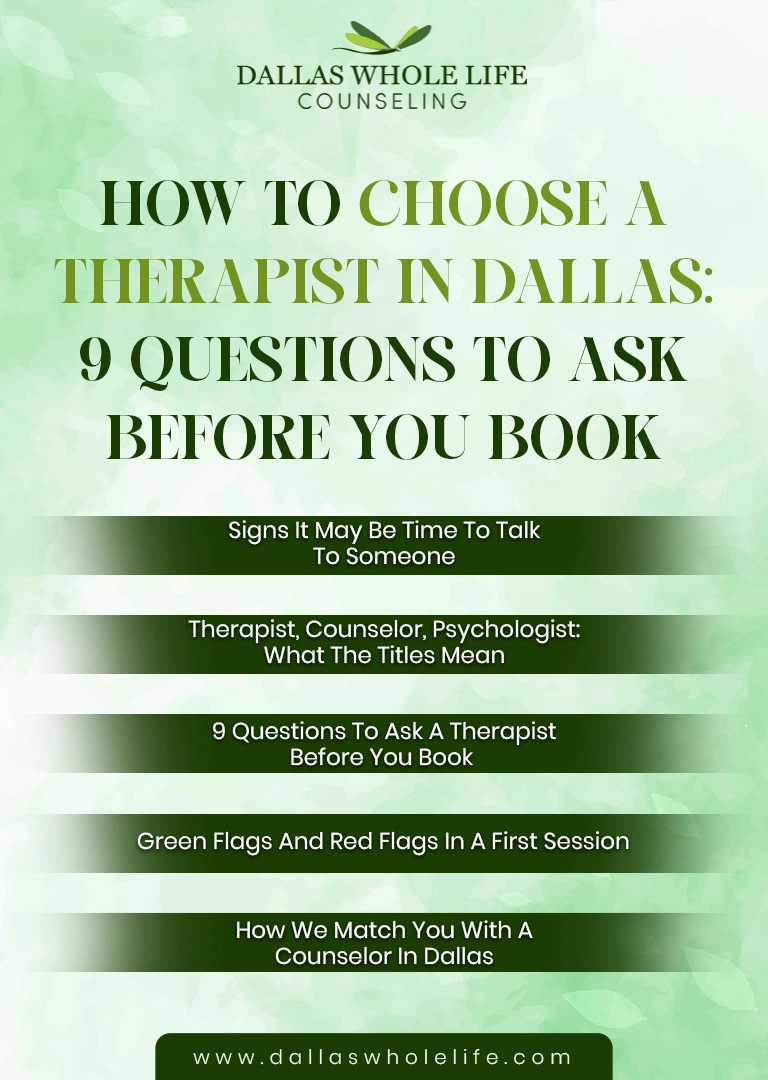
Signs It May Be Time To Talk To Someone

Most people don’t wake up one day and decide they need therapy. It builds slowly. You may notice that stress doesn’t lift, even after a good weekend. You might be sleeping badly or eating much more or much less than usual. Small things at work or home may set you off, or you may have stopped doing things you used to enjoy.
Relationships can show it too. You might feel distant from your partner, snap at your kids, or keep canceling plans because you don’t have the energy.
None of this means something is wrong with you. It may just mean you’re carrying more than you can sort out alone, and a trained person can help. If you’re curious what that first visit is like, check out our guide on what to expect in your first anxiety therapy session.
Therapist, Counselor, Psychologist: What The Titles Mean

People use these words loosely, but in Texas most of them are tied to a state license. A license means the state has reviewed the person’s training and experience. These are the ones you’ll see most often:
| Title | What it stands for | Typical training |
| LPC | Licensed Professional Counselor | Master’s degree in counseling, plus supervised clinical hours |
| LMFT | Licensed Marriage and Family Therapist | Graduate degree in marriage and family therapy or a related field, plus supervised clinical hours |
| LCSW | Licensed Clinical Social Worker | Master’s degree in social work, plus supervised clinical hours |
| Psychologist | Licensed psychologist | Doctoral degree in psychology, plus a supervised internship and postdoctoral hours |
“Therapist” is a general word. Any of these professionals can provide therapy, so the title matters less than two things: that the license is active and that the person has experience with what you’re dealing with. NAMI makes a similar point, noting that a degree alone doesn’t tell you who will suit you, so it helps to look at their interests and specialties (NAMI).
How to check a license in Texas: Use the license search on the Texas Behavioral Health Executive Council website, the state agency that oversees counselors, marriage and family therapists, social workers, and psychologists. It takes about a minute, and any ethical therapist will be fine with you checking.
9 Questions To Ask A Therapist Before You Book

You’re allowed to interview a therapist before you commit. Many offices will let you ask a few questions by phone or in a short first call. Here’s what to ask and what to listen for.
1. Have you helped people with what I’m going through?
Experience with your situation matters more than years in practice. Say it in your own words: “I’ve been worrying constantly, and I can’t sleep. Is that something you work with?” You’re listening for a clear, specific answer, not a vague one.
2. What kind of therapy do you use, and why?
The National Institute of Mental Health suggests asking what approach a therapist will use to help you (NIMH). A good answer is in plain words. For example: “We’ll look at how your thoughts, feelings, and habits affect each other and practice small changes.” If it sounds like a textbook, ask them to explain it again.
3. What does a session look like?
Sessions often run around 45 to 50 minutes, but ask. Find out what the first one involves, whether you’ll mostly talk or also practice skills, and whether you’ll get anything to try between visits. Knowing this ahead of time takes a lot of the nerves out of day one.
4. How will we set goals and check in on progress?
You should be part of setting the goals. Ask how often you’ll look back at them together and what happens if you’re not feeling any movement after a while. A good therapist is glad to talk about this.
5. Do you offer online sessions?
If you want the option, ask which video platform they use, what happens if the connection drops, and whether you can switch between online and in-person. Online sessions can make a weekly appointment much easier to keep, especially with Dallas traffic. Also, make sure your therapist is licensed in Texas. For online sessions, the license generally needs to match the state you’re physically in during the session.
6. Do you take my insurance, or what is the private pay rate?
Have your insurance card nearby. Ask about your copay, how cancellations work, and what the private pay rate is if you’d rather not use insurance. The American Psychological Association also recommends asking about fees and insurance up front. You can check your insurance with us or see our rates before you call.
7. How often will we meet?
Many people start with weekly sessions, then space them out as things settle. Ask what the therapist usually suggests for your situation and whether that can change. It helps to know the time and cost you’re signing up for before you begin.
8. What if it’s not a good fit?
This one tells you a lot. A good therapist welcomes the question and won’t take it personally. You can switch if it isn’t working, and many people try more than one therapist before it clicks. That’s normal.
9. How do you protect my privacy?
Therapy is confidential, with a few exceptions, such as when someone’s safety is at risk. Your therapist should explain these at the start, along with how they store your notes and keep online sessions private. If you’re not sure you understood, ask again.
Green Flags And Red Flags In A First Session

The first session is a two-way test. You’re also finding out whether this person feels right to talk to. Give it two or three visits unless something feels clearly off, because comfort often takes a little time.
Green Flags
- They listen without rushing or interrupting.
- They explain things in plain words.
- They ask what you want to get out of therapy.
- You leave feeling a little clearer, even if the session was hard.
- They respect your pace.
Red Flags
- They talk mostly about themselves.
- They brush off or hurry through your concerns.
- They promise quick fixes or guaranteed results.
- They push you to sign up for lots of sessions before you’ve met.
- They can’t or won’t tell you their license type.
- You feel judged.
Want to meet a few counselors before deciding? You can meet our counselors and read about each one.
In Person Or Online: What Suits You
Neither one is better for everyone. It depends on your life and what feels comfortable.
Online tends to suit you if your schedule is packed, you’d rather skip the drive, you have a quiet private spot at home, or you feel more at ease talking from your own couch.
In person tends to suit you if your home isn’t private, you want a clear break between your home life and therapy, or you simply talk more freely face-to-face.
Some people switch between the two, seeing a therapist in person most weeks and opting for online sessions when work gets busy. You can read more about the differences in our online vs. in-person therapy guide.
How We Match You With A Counselor In Dallas

At Dallas Whole Life Counseling, we’d rather you take your time and pick well than rush into a bad match. Here’s how it works.
Start on our Find a Counselor tool. You can look through our counselors and see who might suit what you’re dealing with. Then book a time that works, either at our Dallas office or online across Texas.
Your first appointment is mostly a conversation. Your counselor asks what brought you in and what you’d like to change, and you can ask any of the nine questions above. You don’t need to have it all figured out. If it doesn’t feel right, tell us, and we’ll help you find someone else on the team. We accept Aetna, BCBS of Texas, Cigna, Medicare, United Healthcare, UMR, and Optum, plus private pay.
Frequently Asked Questions
How many therapists should I try before choosing?
There’s no set number. Some people click with the first one; others talk to two or three. Try to speak with at least a couple if you’re unsure, and give a therapist two or three sessions before deciding. A fit that feels comfortable matters more than a perfect résumé.
Can I switch therapists if it isn’t working?
Yes. You can change therapists at any time, and a good therapist won’t be offended. It can help to say what wasn’t working, because that tells the next person what to do differently. Switching isn’t failing. It’s part of finding the right person.
Is online therapy as helpful as in person?
Many people find online talk therapy works well, and some prefer it. It depends on you, what you’re working on, and whether you have a private, quiet space. If one format doesn’t feel right, you can try the other.
Does insurance cover therapy in Dallas?
Often, yes, but it depends on your plan. Check your benefits for mental health visits, copays, and any deductible. We accept Aetna, BCBS of Texas, Cigna, Medicare, United Healthcare, UMR, and Optum, plus private pay, and you can check your insurance with us.
